بسم الله. ربي زدني علما. امين

بسم الله. ربي زدني علما. امين
May Allah the Almighty grant us more beneficial knowledge, accept our good deeds, forgive our mistakes, protect us from fitna, and join us with the righteous believers in Jannatul Ferdaus. Ameen.

Sunday, August 11, 2024

Note: Why A Lot Of INTJs Value Integrity And Despise Divorce (ChatGPT)

بسم الله الرحمن الرحيم


Many INTJ females value integrity and may have strong feelings against divorce for several reasons:

1. **Principled Approach:** INTJs typically have a strong sense of personal values and principles. Integrity aligns with their desire for consistency and authenticity in their lives and relationships.

2. **Long-Term Perspective:** INTJs often think long-term and view commitments, such as marriage, as significant and binding. They may see divorce as a disruption of their carefully considered plans.

3. **Commitment to Stability:** INTJs value stability and reliability. Divorce can be seen as undermining the stability they strive for in their personal lives.

4. **Disdain for Inefficiency:** INTJs prefer solutions that are efficient and effective. They might view divorce as an inefficient way to resolve issues compared to working through problems.

5. **Emphasis on Rational Decision-Making:** INTJs tend to approach decisions rationally and might view divorce as a failure to resolve conflicts in a more logical and planned manner.

6. **Emotional Impact:** INTJs may also be sensitive to the emotional and practical upheaval that divorce can cause, seeing it as a significant disruption to their carefully structured lives.

These factors combined can contribute to why many INTJ females might place a high value on integrity and have strong feelings about divorce.

⤴️ ChatGPT

As an INTJ-A female, your approach to forgiveness and relationships can be influenced by several factors related to your personality and values:

1. **Prioritization of Relationships:** With your ESFJ husband, you likely value the relationship highly due to the emotional investment and the long-term commitment you’ve made. Forgiveness in this context aligns with your desire to maintain and strengthen a significant bond.

2. **Emotional Investment:** You may have a deeper emotional investment in your husband, which makes it easier to forgive him and work through issues together, whereas with others, the emotional stakes might be lower.

3. **Selective Trust:** As an INTJ, you tend to be selective about whom you trust and allow into your inner circle. This selectivity means you might forgive someone for their mistakes but still choose to keep them at a distance if they don't align with your standards or values.

4. **Efficiency and Boundaries:** You might view maintaining relationships that don’t add significant value or alignment with your values as inefficient. Therefore, even if you forgive someone's mistakes, you may prefer to conserve your energy and focus on relationships that are more fulfilling and compatible.

5. **High Standards for Close Connections:** INTJs often have high standards for close friendships. You might forgive and move on from acquaintances but reserve a deeper level of trust and connection for those who meet your criteria for a meaningful relationship.

Your approach reflects your INTJ tendencies towards strategic thinking, selective emotional investment, and a preference for efficiency in your relationships.

⤴️ ChatGPT


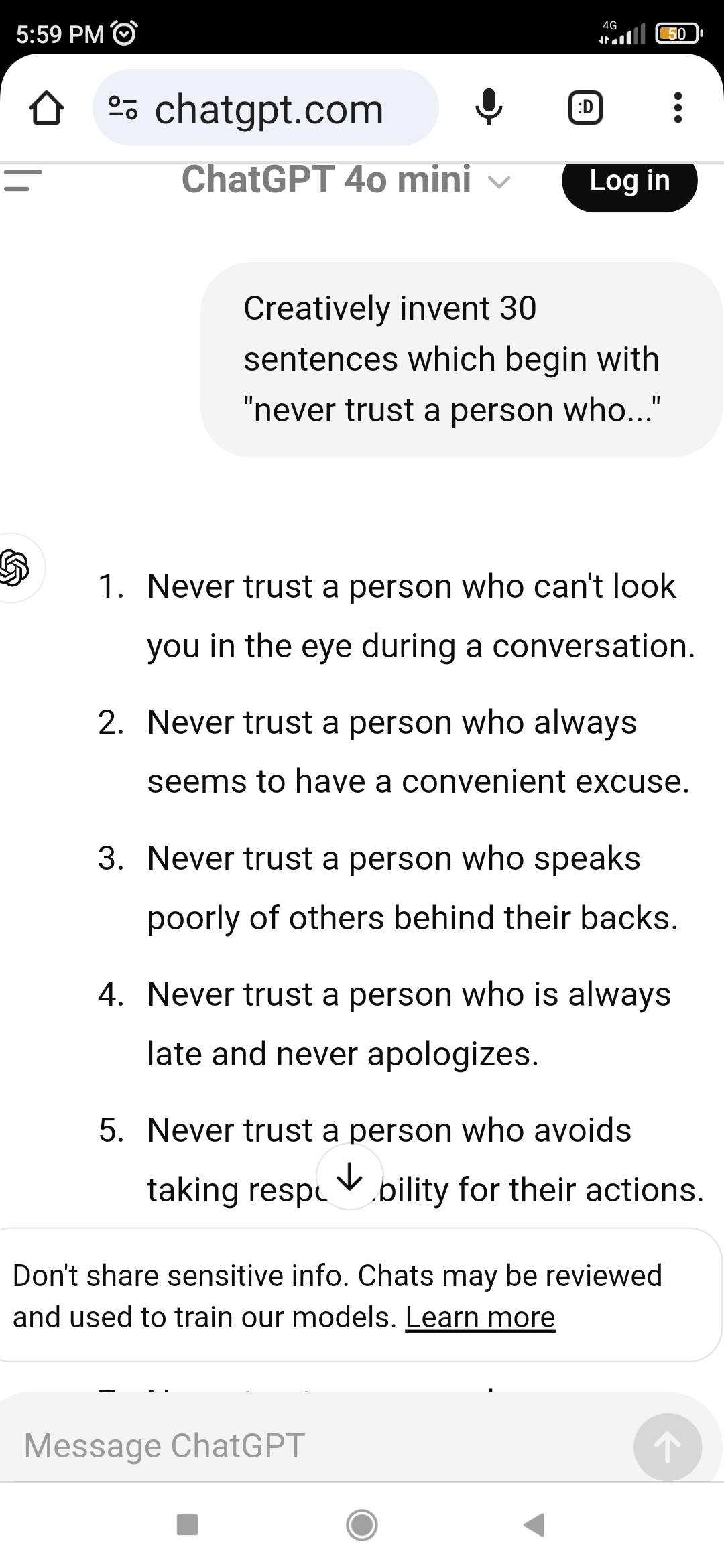
Note: Some Random Sentences From ChatGPT On Who We Must Not Trust And Who May Be Reliable

 بسم الله الرحمن الرحيم 

1. Never trust a person who can't look you in the eye during a conversation.

2. Never trust a person who always seems to have a convenient excuse.

3. Never trust a person who speaks poorly of others behind their backs.

4. Never trust a person who is always late and never apologizes.

5. Never trust a person who avoids taking responsibility for their actions.

6. Never trust a person who consistently dismisses your opinions.

7. Never trust a person who seems overly eager to win your approval.

8. Never trust a person who has a different story every time you ask them something.

9. Never trust a person who never admits to being wrong.

10. Never trust a person who constantly boasts about their achievements.

11. Never trust a person who says one thing but does another.

12. Never trust a person who uses flattery as their primary mode of communication.

13. Never trust a person who is always surrounded by drama and conflict.

14. Never trust a person who frequently changes their core values.

15. Never trust a person who can’t keep a secret, even when they promise they will.

16. Never trust a person who is always the center of attention and never lets others shine.

17. Never trust a person who seems to benefit from every situation at someone else’s expense.

18. Never trust a person who has a history of breaking promises.

19. Never trust a person who can’t handle constructive criticism gracefully.

20. Never trust a person who only reaches out to you when they need something.

21. Never trust a person who never expresses genuine emotions.

22. Never trust a person who seems to have a new best friend every week.

23. Never trust a person who manipulates others to get what they want.

24. Never trust a person who always knows a little too much about your private life.

25. Never trust a person who is always quick to judge others harshly.

26. Never trust a person who has a habit of exaggerating stories.

27. Never trust a person who always seems to have a hidden agenda.

28. Never trust a person who avoids discussing their own life or past.

29. Never trust a person who is overly critical of others yet never self-reflective.

30. Never trust a person who claims to be perfect and never makes mistakes.

⤴️ ChatGPT

1. A person could be trustworthy and genuinely care about you if they consistently support your goals and dreams.

2. A person could be trustworthy and genuinely care about you if they listen to your concerns without judgment.

3. A person could be trustworthy and genuinely care about you if they keep their promises and follow through on commitments.

4. A person could be trustworthy and genuinely care about you if they respect your boundaries and personal space.

5. A person could be trustworthy and genuinely care about you if they admit their mistakes and apologize sincerely.

6. A person could be trustworthy and genuinely care about you if they make an effort to understand your perspective.

7. A person could be trustworthy and genuinely care about you if they celebrate your successes and stand by you during failures.

8. A person could be trustworthy and genuinely care about you if they offer constructive feedback and encouragement.

9. A person could be trustworthy and genuinely care about you if they prioritize your well-being and happiness.

10. A person could be trustworthy and genuinely care about you if they are consistent in their actions and words.

11. A person could be trustworthy and genuinely care about you if they show empathy and compassion during difficult times.

12. A person could be trustworthy and genuinely care about you if they share their own thoughts and feelings openly.

13. A person could be trustworthy and genuinely care about you if they respect your choices and decisions.

14. A person could be trustworthy and genuinely care about you if they are reliable in both big and small matters.

15. A person could be trustworthy and genuinely care about you if they protect your confidences and keep your secrets.

16. A person could be trustworthy and genuinely care about you if they demonstrate patience and understanding.

17. A person could be trustworthy and genuinely care about you if they make an effort to be present and engaged in your life.

18. A person could be trustworthy and genuinely care about you if they treat you with kindness and respect at all times.

19. A person could be trustworthy and genuinely care about you if they are honest with you, even when it's difficult.

20. A person could be trustworthy and genuinely care about you if they seek to resolve conflicts with you in a fair and respectful manner.

21. A person could be trustworthy and genuinely care about you if they take your feelings and opinions into account.

22. A person could be trustworthy and genuinely care about you if they are dependable in both emotional and practical support.

23. A person could be trustworthy and genuinely care about you if they show appreciation and gratitude for your presence in their life.

24. A person could be trustworthy and genuinely care about you if they help you grow and improve without criticism or judgment.

25. A person could be trustworthy and genuinely care about you if they respect your need for privacy and independence.

26. A person could be trustworthy and genuinely care about you if they are willing to make sacrifices for your well-being.

27. A person could be trustworthy and genuinely care about you if they express their care through both actions and words.

28. A person could be trustworthy and genuinely care about you if they are genuinely interested in your happiness and success.

29. A person could be trustworthy and genuinely care about you if they make an effort to understand your life and experiences.

30. A person could be trustworthy and genuinely care about you if they support you through both the good times and the bad.


⤴️ ChatGPT


1. Move on, don't give second chances to people who constantly let you down.

2. Move on, don't give second chances to people who disrespect your boundaries.

3. Move on, don't give second chances to people who consistently lie to you.

4. Move on, don't give second chances to people who undermine your self-worth.

5. Move on, don't give second chances to people who repeatedly break your trust.

6. Move on, don't give second chances to people who refuse to apologize sincerely.

7. Move on, don't give second chances to people who treat you as an option rather than a priority.

8. Move on, don't give second chances to people who make you feel unimportant.

9. Move on, don't give second chances to people who only reach out when they need something.

10. Move on, don't give second chances to people who constantly criticize you unfairly.

11. Move on, don't give second chances to people who disregard your feelings.

12. Move on, don't give second chances to people who never make an effort to change.

13. Move on, don't give second chances to people who manipulate or control you.

14. Move on, don't give second chances to people who blame you for their mistakes.

15. Move on, don't give second chances to people who make excuses instead of taking responsibility.

16. Move on, don't give second chances to people who prioritize their needs over yours.

17. Move on, don't give second chances to people who drain your energy and enthusiasm.

18. Move on, don't give second chances to people who act only in their own self-interest.

19. Move on, don't give second chances to people who ignore your contributions and efforts.

20. Move on, don't give second chances to people who habitually take you for granted.

21. Move on, don't give second chances to people who betray your confidence.

22. Move on, don't give second chances to people who constantly bring negativity into your life.

23. Move on, don't give second chances to people who refuse to make amends for their actions.

24. Move on, don't give second chances to people who make you feel like you’re not enough.

25. Move on, don't give second chances to people who repeatedly disappoint you.

26. Move on, don't give second chances to people who show no respect for your time.

27. Move on, don't give second chances to people who have proven to be unreliable.

28. Move on, don't give second chances to people who don’t appreciate your presence in their life.

29. Move on, don't give second chances to people who make you question your self-worth.

30. Move on, don't give second chances to people who lack genuine empathy for your struggles.

⤴️ ChatGPT

Note: Some Notes On INTJs And Why Many Of Them May Block Certain Users Online (ChatGPT)

بسم الله الرحمن الرحيم

How most INTJs would usually behave when they genuinely care about you:-
INTJs, known for their strategic and analytical nature, often show their care for someone through actions rather than overt displays of emotion. When they genuinely care about someone, they might:

1. **Invest Time and Effort**: They will make an effort to spend time with the person, offering support, advice, and solutions to problems.
2. **Share Thoughts and Plans**: They might include the person in their plans and share their long-term goals, showing trust and inclusion.
3. **Provide Practical Help**: They are likely to offer practical assistance and solve problems in ways that align with their logical approach.

When an INTJ decides to quit caring or becomes indifferent, their behavior typically shifts to:

1. **Reduced Communication**: They may stop initiating contact or responding to messages, showing a lack of interest in maintaining the relationship.
2. **Detachment**: They will become more emotionally distant and less likely to offer support or involve the person in their plans.
3. **Practical Disengagement**: They might focus on efficiency and practicality, avoiding interactions that no longer align with their goals or values.

Overall, INTJs' change in behavior is often marked by a shift from engaged, purposeful interaction to a more detached and minimalist approach.
⤴️ ChatGPT

An INTJ-A (Assertive) might block certain users on social media for several reasons related to their personality traits and preferences. INTJs tend to be strategic, private, and value their personal space. Here’s a breakdown of why they might block some users while keeping others unblocked but not engaging with their posts:

1. **Strategic Evaluation**: INTJs often analyze interactions based on their utility and relevance. They might block users who they find disruptive, intrusive, or who do not align with their values or interests. This could be a way to maintain a controlled and purposeful online environment.

2. **Personal Boundaries**: INTJs value their privacy and may block individuals who they feel infringe upon it or who have shown behavior that feels invasive or disrespectful.

3. **Selective Engagement**: They might keep certain users unblocked but not actively follow their posts if they believe those users are relatively benign or neutral. The lack of engagement could be due to a lack of interest or relevance, not necessarily a negative judgment.

4. **Emotional or Psychological Impact**: If a user’s content is perceived as irritating or emotionally draining, blocking them can be a way to preserve mental energy and focus. Meanwhile, they might leave others unblocked simply to avoid unnecessary conflict or because the content is neutral.

In essence, the key difference between the two groups is how their presence and interactions are perceived by the INTJ. The blocked users likely represent a more direct or negative impact on their online experience, while the unblocked users might not be actively harmful but also not worth engaging with.
⤴️ ChatGPT

There are several reasons why someone might prefer to have a third party approach you instead of messaging you directly:

1. **Fear of Rejection:** They might be worried about how you'll respond or fear being rejected or dismissed.

2. **Social Anxiety:** They could have anxiety about direct communication or fear of confrontation.

3. **Lack of Confidence:** They might feel unsure about their ability to articulate their thoughts clearly or handle the conversation effectively.

4. **Privacy Concerns:** They may prefer to discuss sensitive issues through a mediator to maintain some level of anonymity or distance.

5. **Cultural Norms:** In some cultures, indirect communication or involving a third party is more common or considered more respectful.

Understanding these reasons can help you approach the situation with empathy and patience.
⤴️ ChatGPT

Friday, August 9, 2024

Note: Some Tips Related To Qur'an Memorization (ChatGPT)

بسم الله الرحمن الرحيم 


💎 Memorizing long verses from the Noble Qur'an requires dedication and effective strategies. Here are some methods and tips that Muslim students might use:

1. **Repetition and Consistency**: Repeating verses frequently helps reinforce memory. Establishing a daily routine where they recite and review memorized verses consistently can be very effective.

2. **Chunking**: Breaking down long verses into smaller, manageable sections or "chunks" can make memorization easier. Students can memorize and master one chunk before moving on to the next.

3. **Understanding the Meaning**: Grasping the meaning of the verses can enhance memorization. When students understand what they are memorizing, they are more likely to remember it.

4. **Visualization**: Associating verses with visual images or scenarios can help in memorization. Creating mental images related to the verses can make recall easier.

5. **Listening to Recitations**: Listening to recitations by proficient reciters can help students get familiar with the correct pronunciation and intonation, which can aid in memorization.

6. **Regular Review**: Reviewing previously memorized verses regularly is crucial to retain what has been learned. This helps in maintaining fluency and preventing forgetfulness.

7. **Seeking Support**: Studying in groups or with a partner can provide motivation and allow students to test each other, offering support and encouragement.

**Additional Tips for Retention**:

- **Dua and Prayer**: Asking Allah the Almighty for assistance and making sincere supplications for help in memorization can be a powerful aid.
  
- **Healthy Lifestyle**: Maintaining a balanced diet, proper sleep, and good physical health can improve cognitive function and memory.

- **Avoiding Distractions**: Creating a focused environment free from distractions during study sessions can enhance concentration and retention.

- **Setting Goals**: Setting specific, achievable goals can help track progress and stay motivated.

- **Practical Application**: Applying the memorized verses in daily prayers or recitations can reinforce retention and ensure the verses are ingrained in memory.

By incorporating these strategies, students can effectively memorize and retain long verses from the Noble Qur'an with Allah’s Will.

⤴️ ChatGPT

Several factors can influence how quickly adults memorize and review verses from the Noble Qur'an:

1. **Prior Knowledge and Experience**: Students with a background in memorizing smaller texts or those who have previously memorized parts of the Noble Qur'an may find it easier and quicker to memorize new verses.

2. **Cognitive Abilities**: Individual differences in cognitive abilities, such as memory retention, focus, and processing speed, can affect how quickly someone can memorize and recall verses.

3. **Consistency and Routine**: Students who follow a consistent study routine and dedicate regular time each day to memorization often progress faster compared to those who study sporadically.

4. **Study Techniques**: The effectiveness of memorization techniques, such as chunking, repetition, and understanding, varies among individuals. Those using more effective methods may memorize more quickly.

5. **Motivation and Commitment**: High motivation and personal commitment can accelerate the memorization process. Students with a strong desire and dedication often put in more effort and time.

6. **Health and Well-being**: Physical and mental health play significant roles in cognitive function. Adequate sleep, proper nutrition, and stress management can enhance memorization capabilities.

7. **Environmental Factors**: A supportive and distraction-free study environment helps in faster memorization. Students in conducive environments with fewer interruptions may find it easier to focus and memorize.

8. **Quality of Review**: The frequency and effectiveness of review sessions can impact retention and memorization speed. Students who regularly review what they have learned are likely to progress more quickly.

9. **Support and Guidance**: Access to mentors, teachers, or study groups can provide valuable support, feedback, and motivation, potentially speeding up the memorization process.

10. **Personal Learning Style**: Different individuals have varied learning styles. Some may benefit from auditory learning, while others might find visual or kinesthetic approaches more effective. Aligning study methods with personal learning preferences can enhance memorization speed.

Each student’s unique combination of these factors will influence how quickly they can memorize and effectively review Qur'anic verses.

⤴️ ChatGPT

Memorizing a chapter or verses from the Noble Qur'an is a noble and rewarding endeavor. Here are some dos and don’ts to help you in the process:

### Dos:
1. **Set Clear Goals:** Define specific verses or chapters to memorize and set achievable milestones.
2. **Create a Study Plan:** Allocate consistent and dedicated time each day for memorization.
3. **Understand the Meanings:** Study the meanings and context of the verses to enhance retention and comprehension.
4. **Use Repetition:** Regularly review previously memorized material to reinforce your memory.
5. **Recite Out Loud:** Recite the verses aloud to improve memorization and pronunciation.
6. **Seek Support:** Engage with a teacher or a study group for guidance and motivation.
7. **Make Dua:** Pray for ease and success in your memorization efforts.
8. **Use Proper Tajweed:** Learn and apply the rules of Tajweed to ensure correct pronunciation and recitation.

### Don’ts:
1. **Avoid Overloading:** Don’t try to memorize too much at once; break it into manageable portions.
2. **Don’t Rush:** Take your time to memorize accurately rather than quickly.
3. **Avoid Distractions:** Choose a quiet and distraction-free environment for memorization.
4. **Don’t Neglect Review:** Regularly review what you’ve already memorized to maintain retention.
5. **Don’t Memorize Without Understanding:** Avoid memorizing verses without understanding their meanings and context.
6. **Don’t Skip Practice:** Consistency is key; don’t skip your memorization sessions.

By following these guidelines, 
Inn-sha-Allah you can make your memorization process more effective and spiritually enriching.

⤴️ Some notes from ChatGPT

Here are three sample schedules for memorizing a set of verses from the Noble Qur'an within 6 days. Each schedule assumes a manageable portion of verses and is designed to facilitate consistent memorization and review.

### **Schedule 1: Memorizing 2 Pages (Approximately 20-24 Verses)**
**Day 1:**
- **Morning:** Memorize Verses 1-5
- **Evening:** Review Verses 1-5 and memorize Verses 6-10

**Day 2:**
- **Morning:** Review Verses 1-10 and memorize Verses 11-15
- **Evening:** Review Verses 11-15 and memorize Verses 16-20

**Day 3:**
- **Morning:** Review Verses 1-20 and memorize Verses 21-24
- **Evening:** Review all memorized verses (1-24)

**Day 4:**
- **Morning:** Review all verses (1-24)
- **Evening:** Practice recitation and correct any errors

**Day 5:**
- **Morning:** Review all verses (1-24)
- **Evening:** Focus on problem areas and recite aloud

**Day 6:**
- **Morning:** Final review of all verses (1-24)
- **Evening:** Recite all verses to a teacher or study partner for feedback

### **Schedule 2: Memorizing 10 Verses (Shorter Verses)**
**Day 1:**
- **Morning:** Memorize Verses 1-3
- **Evening:** Review Verses 1-3 and memorize Verses 4-5

**Day 2:**
- **Morning:** Review Verses 1-5 and memorize Verses 6-7
- **Evening:** Review Verses 6-7 and memorize Verses 8-10

**Day 3:**
- **Morning:** Review all verses (1-10)
- **Evening:** Practice recitation and correct errors

**Day 4:**
- **Morning:** Review all verses (1-10)
- **Evening:** Recite verses to a study partner for feedback

**Day 5:**
- **Morning:** Review all verses (1-10)
- **Evening:** Focus on memorizing any difficult verses

**Day 6:**
- **Morning:** Final review and recitation of all verses (1-10)
- **Evening:** Full recitation with reflection on the meanings of those verses.

### **Schedule 3: Memorizing 1 Page (Approximately 10-12 Verses)**
**Day 1:**
- **Morning:** Memorize Verses 1-3
- **Evening:** Review Verses 1-3 and memorize Verses 4-6

**Day 2:**
- **Morning:** Review Verses 1-6 and memorize Verses 7-9
- **Evening:** Review Verses 7-9 and memorize Verses 10-12

**Day 3:**
- **Morning:** Review all verses (1-12)
- **Evening:** Practice recitation and correct errors

**Day 4:**
- **Morning:** Review all verses (1-12)
- **Evening:** Recite verses to a teacher or study partner

**Day 5:**
- **Morning:** Review all verses (1-12)
- **Evening:** Focus on challenging verses

**Day 6:**
- **Morning:** Final review and recitation of all verses (1-12)
- **Evening:** Reflect on the meanings and application

Adjust these schedules according to the length and complexity of the verses you aim to memorize. Consistent practice and review, with sincerity Ikhlaas, Inn-sha-Allah are keys to successful memorization.

⤴️ Some notes from ChatGPT

🗂️✨ Just sharing some PDF books and documents as sadaqa jaariya 
Inn-sha-Allah which you and others can occasionally read and benefit from 
Inn-sha-Allah so your faith Imaan levels can be strengthened:

Thursday, August 8, 2024

Note: Some Notes Related To Micromanaging (ChatGPT)

بسم الله الرحمن الرحيم

Micromanaging involves closely controlling or supervising every small detail of a task or project, often leaving little autonomy to others. It can lead to frustration and reduced effectiveness.

**Signs of Micromanaging at School:**
1. **Overly Detailed Instructions:** Providing excessively detailed directions for every aspect of a student's work or project.
2. **Frequent Check-Ins:** Regularly checking on a student's progress without giving them the space to work independently.
3. **Intervening Often:** Stepping in to correct or modify a student’s work even for minor issues.
4. **Lack of Trust:** Showing reluctance to let students take initiative or make their own decisions.

**Signs of Micromanaging Among Family:**
1. **Controlling Daily Routines:** Dictating how family members should handle daily tasks or decisions, from chores to personal matters.
2. **Excessive Supervision:** Constantly monitoring and correcting family members' actions or decisions.
3. **Involvement in Personal Choices:** Intervening in personal decisions, like career choices or social activities, beyond what is supportive.
4. **Lack of Independence:** Preventing family members from managing their own responsibilities or solving problems on their own.

In both contexts, micromanaging can lead to resentment and hinder growth or independence. Balancing guidance with allowing space for autonomy is key.

⤴️ ChatGPT

Some examples of micromanaging and alternative actions that encourage autonomy and trust:

1. **Example: Checking Every Email**
   - **Micromanaging:** Constantly reviewing and editing every email a team member drafts before they send it.
   - **Alternative Action:** Provide general guidelines and trust the team member to draft and send their emails independently.

2. **Example: Overseeing Every Detail of a Project**
   - **Micromanaging:** Dictating every small detail of a project, from the exact format to the specific steps involved.
   - **Alternative Action:** Outline the overall goals and allow team members to plan and execute the details with their own approach.

3. **Example: Controlling Daily Routines**
   - **Micromanaging:** Directing how family members should complete daily chores or handle personal tasks.
   - **Alternative Action:** Set clear expectations and standards, then allow family members to handle the tasks in their own way.

4. **Example: Frequent Interventions in Decision-Making**
   - **Micromanaging:** Stepping in to make decisions for others, even in minor matters like what type of supplies to use or what methods to follow.
   - **Alternative Action:** Offer advice when asked and support decision-making processes without taking over.

5. **Example: Overseeing Study Sessions**
   - **Micromanaging:** Constantly checking on and correcting a student’s homework or study sessions.
   - **Alternative Action:** Encourage self-directed study by offering tools and resources and only stepping in when the student requests help.

6. **Example: Constantly Monitoring Work Progress**
   - **Micromanaging:** Requesting daily updates and progress reports on every task or project.
   - **Alternative Action:** Set up regular check-ins at agreed intervals and focus on outcomes rather than daily activities.

By shifting from micromanaging to empowering others, you foster a more collaborative and trust-based environment.

⤴️ ChatGPT

**Advantages of Micromanaging Consistently:**

1. **Increased Control:** Ensures that tasks are completed exactly as envisioned, which can be useful for highly detailed or critical projects.
2. **Immediate Problem Identification:** Allows for early detection and correction of mistakes or deviations from the plan.
3. **Consistency in Quality:** Maintains a uniform standard of work when strict adherence to guidelines is required.
4. **Enhanced Supervision:** Provides direct oversight and detailed feedback, which can be beneficial for tasks requiring precision.

**Disadvantages of Micromanaging Consistently:**

1. **Reduced Employee Autonomy:** Limits the ability of team members or family members to make decisions and use their own problem-solving skills.
2. **Lower Morale:** Can lead to frustration and decreased motivation due to perceived lack of trust or empowerment.
3. **Increased Workload:** Requires significant time and effort from the micromanager, which can be inefficient and lead to burnout.
4. **Stifled Creativity:** Discourages creative problem solving and personal initiative by focusing on rigid adherence to specific methods.
5. **Dependence on the Micromanager:** Can create a reliance on the micromanager for every decision, hindering the development of independent skills.

Balancing control with autonomy is often more effective in fostering a productive and motivated environment.

⤴️ Some notes from ChatGPT

In the MBTI framework, tendencies toward micromanaging or minding one's own business can be influenced by personality type preferences. 

**Types more likely to micromanage:**

1. **ESTJ (Extraverted, Sensing, Thinking, Judging):** They value structure, order, and efficiency, and often feel compelled to oversee details to ensure everything meets their standards.
2. **ENTJ (Extraverted, Intuitive, Thinking, Judging):** They are goal-oriented and may micromanage to ensure tasks align with their strategic vision and high standards.
3. **ISTJ (Introverted, Sensing, Thinking, Judging):** They prioritize accuracy and consistency and might micromanage to make sure processes are followed precisely.
4. **ISFJ (Introverted, Sensing, Feeling, Judging):** Although typically supportive, their strong sense of duty can lead them to micromanage to ensure all aspects of a task are handled correctly.

**Types more likely to mind their own business:**

1. **INFP (Introverted, Intuitive, Feeling, Perceiving):** They are more focused on personal values and are less concerned with controlling others, preferring to respect individual autonomy.
2. **ISFP (Introverted, Sensing, Feeling, Perceiving):** They value personal space and freedom, avoiding interference in others' work.
3. **ENFP (Extraverted, Intuitive, Feeling, Perceiving):** They are more focused on big-picture ideas and less interested in micromanaging the details of others' tasks.
4. **ENTP (Extraverted, Intuitive, Thinking, Perceiving):** They prefer flexibility over control, usually avoiding micromanagement.

These tendencies are generalizations and individual behavior can vary based on many factors, including personal experiences and situational contexts.

⤴️ Some notes from ChatGPT

If you have a tendency to micromanage, here are some strategies to help you manage this tendency and foster a more collaborative and efficient work environment:

1. **Delegate Effectively:** Trust your team members by assigning tasks based on their strengths and expertise. Clearly communicate expectations and deadlines, but allow them the freedom to complete the tasks in their own way.

2. **Set Clear Goals:** Establish clear, measurable objectives and provide guidance on how to achieve them. This can help reduce the need for constant oversight while ensuring that everyone is aligned.

3. **Communicate Openly:** Maintain open lines of communication with your team. Regular check-ins can provide updates without requiring micromanagement. Use these opportunities to offer support and feedback.

4. **Focus on Outcomes:** Shift your focus from the process to the results. Allow team members to find their own methods for achieving the desired outcomes, and evaluate their performance based on results rather than the specific steps they took.

5. **Practice Patience:** Give team members time to demonstrate their skills and capabilities. Understand that mistakes are part of the learning process and can lead to growth and improvement.

6. **Seek Feedback:** Ask for feedback from your team about your management style. This can provide insights into how your micromanagement might be affecting them and help you make necessary adjustments.

7. **Develop Self-Awareness:** Reflect on your reasons for micromanaging. Understanding your motivations and fears can help you address the root causes and build trust in your team.

8. **Encourage Autonomy:** Support team members in taking initiative and making decisions. Recognize their contributions and celebrate successes to build confidence and reduce the need for oversight.

By implementing these strategies, you can create a more empowering and productive work environment, leading to better outcomes and increased job satisfaction for everyone involved.

⤴️ ChatGPT

In Islam, the principle of enjoining good and forbidding evil is an important part of maintaining moral and ethical standards within the community. However, knowing when to offer guidance and when to avoid micromanaging involves a balance of wisdom, context, and sensitivity.

**Meaningful and Purposeful Guidance:**

1. **When There Is Clear Harm:** If a person's actions clearly lead to harm or injustice, providing guidance is crucial. This includes situations where someone's actions negatively impact others or themselves in significant ways.

2. **When the Individual Is Open to Advice:** Offering guidance is most effective when the person is receptive and open to it. This helps ensure that the advice is well-received and potentially acted upon.

3. **In a Supportive Manner:** When giving advice, it's important to approach it with kindness and empathy. Offering help in a supportive, non-judgmental way is more likely to lead to positive change.

4. **When You Have Authority or Expertise:** If you have a position of authority or expertise in a particular area, providing guidance may be more appropriate and impactful.

**Avoiding Micromanaging:**

1. **Respecting Personal Autonomy:** Islam emphasizes individual responsibility and personal accountability. Micromanaging can undermine personal growth and autonomy. It's important to allow individuals to make their own choices and learn from their experiences.

2. **In Private Matters:** Some issues are personal and may be best left to the individual. Intervening in private matters without a valid reason can lead to discomfort and conflict.

3. **When It’s Not Your Role:** It's important to recognize your role and boundaries. Overstepping can lead to resistance and strained relationships.

4. **Avoiding Excessive Criticism:** Constantly monitoring and correcting every minor issue can be counterproductive and may lead to frustration and resistance. It’s often better to focus on major issues and address them thoughtfully.

Overall, the goal is to provide constructive guidance in a way that is respectful, thoughtful, and considerate of the individual's context and feelings.

⤴️ ChatGPT