بسم الله. ربي زدني علما. امين

بسم الله. ربي زدني علما. امين
May Allah the Almighty grant us more beneficial knowledge, accept our good deeds, forgive our mistakes, protect us from fitna, and join us with the righteous believers in Jannatul Ferdaus. Ameen.

Thursday, October 24, 2024

Note: The 16 MBTI Personality Types And Things They May Be Confident In (ChatGPT and Meta AI)

بسم الله الرحمن الرحيم


❓ Question: What are 3 things which each of the 16 MBTI personality types are typically skilled and confident in and give 3 examples of situations in which their confidence is evident?
💻 ChatGPT: Here’s an overview of the 16 MBTI personality types, highlighting three typical skills or areas of confidence for each type, along with examples of situations that demonstrate this confidence:

### 1. **ISTJ (Inspector)**
   - **Skills:** Organization, Reliability, Attention to Detail
   - **Situations:**
     1. Leading a team in a project with a strict deadline, ensuring all tasks are on schedule.
     2. Conducting a thorough audit at work, presenting findings with clarity.
     3. Planning a family event, coordinating every detail to ensure it runs smoothly.

### 2. **ISFJ (Protector)**
   - **Skills:** Empathy, Practicality, Commitment
   - **Situations:**
     1. Volunteering to support a colleague in distress, providing emotional and logistical help.
     2. Organizing community service events, bringing people together for a common cause.
     3. Managing household tasks efficiently, creating a stable environment for family members.

### 3. **INFJ (Counselor)**
   - **Skills:** Insightfulness, Compassion, Visionary Thinking
   - **Situations:**
     1. Leading discussions on mental health awareness, connecting with participants deeply.
     2. Mentoring a junior colleague, offering guidance that inspires personal growth.
     3. Writing impactful articles on social issues, resonating with a wide audience.

### 4. **INTJ (Mastermind)**
   - **Skills:** Strategic Planning, Analytical Thinking, Independence
   - **Situations:**
     1. Developing a long-term business strategy, anticipating industry trends.
     2. Presenting a complex technical solution to stakeholders confidently.
     3. Pursuing a personal project, demonstrating self-discipline and vision.

### 5. **ISTP (Crafter)**
   - **Skills:** Problem-Solving, Technical Skills, Adaptability
   - **Situations:**
     1. Fixing a complex machine on the job, troubleshooting efficiently.
     2. Navigating a challenging outdoor adventure, making quick decisions.
     3. Creating a custom gadget or tool, showcasing practical skills and creativity.

### 6. **ISFP (Composer)**
   - **Skills:** Artistic Expression, Sensitivity to Aesthetics, Spontaneity
   - **Situations:**
     1. Displaying artwork.
     2. Planning a spontaneous trip, embracing new experiences and cultures.
     3. Organizing a get-together with those few individuals whom they feel closely connected to.
(Modified)

### 7. **INFP (Mediator)**
   - **Skills:** Creativity, Idealism, Empathy
   - **Situations:**
     1. Writing a thought-provoking piece on personal values, inspiring others.
     2. Advocating for a social cause.
     3. Facilitating certain group discussions, fostering understanding and collaboration.

### 8. **INTP (Thinker)**
   - **Skills:** Critical Thinking, Innovation, Theoretical Analysis
   - **Situations:**
     1. Engaging in debates, presenting well-structured arguments.
     2. Developing a new software program, demonstrating technical expertise.
     3. Researching complex theories, contributing original insights to a field.

### 9. **ESTP (Entrepreneur)**
   - **Skills:** Risk-Taking, Negotiation, Action Orientation
   - **Situations:**
     1. Closing a big business deal, using charisma to influence others.
     2. Competing in an extreme sport, displaying confidence under pressure.
     3. Organizing a last-minute event, thriving in fast-paced environments.

### 10. **ESFP (Entertainer)**
   - **Skills:** Charisma, People Skills, Spontaneity
   - **Situations:**
     1. Hosting a lively gathering, engaging the many guests with enthusiasm.
     2. Performing on stage in front of a large audience with energy and presence.
     3. Planning a group outing, bringing their families or friends together for fun (halal/permissible fun) activities.

### 11. **ENFP (Campaigner)**
   - **Skills:** Creativity, Enthusiasm, Persuasion
   - **Situations:**
     1. Leading a brainstorming session, inspiring innovative ideas.
     2. Advocating for a new initiative at work, rallying support from colleagues.
     3. Creating engaging content for social media, resonating with their followers.

### 12. **ENTP (Debater)**
   - **Skills:** Quick Thinking, Debate, Innovation
   - **Situations:**
     1. Challenging assumptions in a meeting, stimulating critical thinking.
     2. Launching a startup, creatively solving problems in real time.
     3. Engaging in group discussions at a conference.

### 13. **ESTJ (Supervisor)**
   - **Skills:** Leadership, Organization, Decision-Making
   - **Situations:**
     1. Overseeing a team project, ensuring everyone meets their goals.
     2. Implementing new policies in the workplace, managing change effectively.
     3. Coordinating community activities, demonstrating strong organizational skills.

### 14. **ESFJ (Provider)**
   - **Skills:** Social Awareness, Nurturing, Organization
   - **Situations:**
     1. Planning a charity event, rallying volunteers and donations successfully.
     2. Hosting family gatherings, creating a welcoming and enjoyable atmosphere.
     3. Supporting a friend in crisis, offering practical help and emotional support.

### 15. **ENFJ (Protagonist)**
   - **Skills:** Leadership, Empathy, Communication
   - **Situations:**
     1. Leading a community organization, inspiring members to take action.
     2. Facilitating team-building exercises, fostering strong connections at school or in the workplace.
     3. Delivering motivational speeches, encouraging positive energy.
(Modified)

### 16. **ENTJ (Commander)**
   - **Skills:** Strategic Thinking, Leadership, Efficiency
   - **Situations:**
     1. Directing a project, confidently making tough decisions.
     2. Networking at industry events, leveraging connections to create opportunities.
     3. Running for a leadership position in an organization, articulating a clear vision.

This summary encapsulates the core strengths and confidence levels of each MBTI type, illustrated through relatable scenarios.

🌐 Meta AI: Here's a breakdown of the 16 MBTI personality types, their typical skills and confidence areas, and three situations where their confidence shines:

*ISTJ (Introverted, Sensing, Thinking, Judging)*
Skilled in: Organization, analysis, practical problem-solving
Confident in: Planning, decision-making, attention to detail

Situations:
1. Managing complex projects with tight deadlines
2. Analyzing data to optimize processes
3. Ensuring accuracy in financial records

*ISFJ (Introverted, Sensing, Feeling, Judging)*
Skilled in: Supporting others, remembering details, creating harmony
Confident in: Mediating conflicts, providing emotional support, maintaining order

Situations:
1. Resolving team conflicts and improving morale
2. Coordinating events and ensuring smooth logistics
3. Offering empathetic counsel to friends and family

*INFJ (Introverted, Intuitive, Feeling, Judging)*
Skilled in: Empathizing, strategizing, inspiring others
Confident in: Understanding people's motivations, envisioning futures, leading teams

Situations:
1. Motivating team members to achieve shared goals
2. Developing innovative solutions to social issues
3. Facilitating meaningful discussions and workshops

*INTJ (Introverted, Intuitive, Thinking, Judging)*
Skilled in: Strategizing, analyzing complex systems, suggesting creative or feasible ideas when planning in a group or team 
Confident in: Solving complex problems, predicting outcomes, leading change

Situations:
1. Developing revolutionary products or services
2. Analyzing market trends and forecasting growth
3. Streamlining inefficient processes 
(Modified)

*ISTP (Introverted, Sensing, Thinking, Perceiving)*
Skilled in: Troubleshooting, adapting, hands-on problem-solving
Confident in: Fixing equipment, improvising solutions, navigating uncertainty

Situations:
1. Repairing complex machinery or electronics
2. Responding to emergency situations with calm expertise
3. Improvising creative solutions under pressure

*ISFP (Introverted, Sensing, Feeling, Perceiving)*
Skilled in: Creating, supporting, appreciating beauty
Confident in: Expressing artistic vision, empathizing with others, exploring possibilities

Situations:
1. Bringing creative ideas to design projects
2. Offering emotional support and validation to those whom they feel closely connected to 
3. Exploring unconventional solutions to creative challenges
(Modified)

*INFP (Introverted, Intuitive, Feeling, Perceiving)*
Skilled in: Empathizing, idealizing, communicating values
Confident in: Inspiring others, advocating for justice, writing compellingly

Situations:
1. Writing persuasive articles or speeches
2. Advocating for social justice causes
3. Facilitating meaningful discussions and debates

*INTP (Introverted, Intuitive, Thinking, Perceiving)*
Skilled in: Analyzing, theorizing, debating
Confident in: Challenging assumptions, generating innovative ideas, arguing logically

Situations:
1. Engaging in intellectual debates or discussions
2. Developing novel theories or models
3. Critiquing and improving existing systems

*ESTP (Extraverted, Sensing, Thinking, Perceiving)*
Skilled in: Action-oriented, negotiating, persuading
Confident in: Taking calculated risks, negotiating deals, persuading others

Situations:
1. Closing business deals or negotiating contracts
2. Responding to emergency situations with decisive action
3. Persuading teams to adopt new initiatives

*ESFP (Extraverted, Sensing, Feeling, Perceiving)*
Skilled in: Dispelling boredom, motivating, improvising
Confident in: Engaging audiences, generating enthusiasm, thinking on feet

Situations:
1. Hosting events or performances
2. Motivating teams with energetic presentations
3. Improvising creative solutions in high-pressure situations

*ENFP (Extraverted, Intuitive, Feeling, Perceiving)*
Skilled in: Inspiring, communicating, envisioning
Confident in: Motivating others, generating new ideas, facilitating growth

Situations:
1. Delivering inspiring speeches or presentations
2. Facilitating team brainstorming and ideation
3. Developing innovative marketing campaigns

*ENTP (Extraverted, Intuitive, Thinking, Perceiving)*
Skilled in: Thinking of creative strategies or numerous solutions, debating, strategizing
Confident in: Challenging status quo, generating wide range of solutions, arguing persuasively

Situations:
1. Developing revolutionary products or services
2. Engaging in intellectual debates or discussions
3. Strategizing business growth and expansion
(Modified)

*ESTJ (Extraverted, Sensing, Thinking, Judging)*
Skilled in: Organizing, leading, analyzing
Confident in: Managing teams, making tough decisions, optimizing processes

Situations:
1. Leading teams through complex projects
2. Analyzing data to inform strategic decisions
3. Implementing efficient systems and procedures

*ESFJ (Extraverted, Sensing, Feeling, Judging)*
Skilled in: Supporting, organizing, mediating
Confident in: Facilitating teamwork, resolving conflicts, creating harmony

Situations:
1. Coordinating events and ensuring smooth logistics
2. Mediating team conflicts and improving morale
3. Providing emotional support and guidance

*ENFJ (Extraverted, Intuitive, Feeling, Judging)*
Skilled in: Inspiring, leading, communicating
Confident in: Motivating teams, envisioning futures, facilitating growth

Situations:
1. Delivering inspiring speeches or presentations
2. Leading teams through change and self-improvement 
3. Developing strategic plans and initiatives
(Modified)

*ENTJ (Extraverted, Intuitive, Thinking, Judging)*
Skilled in: Strategizing, leading, thinking of creative solutions and ideas
Confident in: Visioning futures, leading change, solving complex problems

Situations:
1. Developing revolutionary products or services
2. Leading teams through complex strategic initiatives
3. Analyzing market trends and forecasting growth
(Modified)

Remember, these are general tendencies and not absolute predictions. Individuals may exhibit different strengths and confidence areas based on personal experiences and development.

Keep in mind:
1. MBTI is not a science, but rather a framework for understanding preferences.
2. Context and situation-specific confidence can vary.
3. Personal growth and self-awareness can influence confidence areas.

Use this information to:
1. Identify potential strengths and areas for growth.
2. Develop strategies to build confidence.
3. Appreciate individual differences and diversity.

❓ Question: What are 3 things which each of the MBTI personality types generally struggle with or could stereotypically be awkward at unless they learn those things and why?
💻 ChatGPT: Here's a breakdown of common struggles or awkwardness faced by each MBTI personality type, along with explanations:

### 1. **ISTJ (Inspector)**
   - **Struggles:** 
     1. **Flexibility:** May find it challenging to adapt to unexpected changes.
     2. **Emotional Expression:** Can struggle with expressing feelings openly.
     3. **Spontaneity:** Often prefers planning over spontaneity, which can lead to rigidity.
   - **Why:** Their preference for structure and rules makes it difficult to navigate ambiguity and emotional nuances.

### 2. **ISFJ (Protector)**
   - **Struggles:** 
     1. **Assertiveness:** May have trouble standing up for themselves or their needs.
     2. **Change Acceptance:** Can be resistant to new ideas or changes in routine.
     3. **Conflict Resolution:** Might avoid confrontation, leading to unresolved issues.
   - **Why:** Their strong desire to not disappoint loved ones at times can hinder their ability to assert themselves.
(Modified)

### 3. **INFJ (Counselor)**
   - **Struggles:**
     1. **Practicality:** May struggle with applying their insights in real-world situations.
     2. **Self-Promotion:** Can be awkward in showcasing their achievements or talents.
     3. **Boundaries:** Often take on others' emotions, leading to burnout.
   - **Why:** Their focus on deeper meanings can make them overlook practicalities and self-advocacy.

### 4. **INTJ (Mastermind)**
   - **Struggles:**
     1. **Social Interaction:** May feel awkward in casual social settings.
     2. **Emotional Connectivity:** Can struggle to relate to others' feelings.
     3. **Collaboration:** Often prefer working alone, which can hinder teamwork.
   - **Why:** Their analytical mindset can lead to a disconnect with more emotional or social contexts.

### 5. **ISTP (Crafter)**
   - **Struggles:**
     1. **Long-Term Planning:** May have difficulty with long-term commitments.
     2. **Routine:** Can feel confined by repetitive tasks.
     3. **Emotional Communication:** Might find it hard to articulate feelings.
   - **Why:** Their focus on the present can lead to neglecting future implications or emotional depth.

### 6. **ISFP (Composer)**
   - **Struggles:**
     1. **Organization:** May struggle with maintaining order and structure.
     2. **Decision-Making:** Can be indecisive, especially under pressure.
     3. **Public Speaking:** Often feel uncomfortable in front of large groups.
   - **Why:** Their spontaneous and free-spirited nature can clash with demands for structure and decisiveness.

### 7. **INFP (Mediator)**
   - **Struggles:**
     1. **Confrontation:** Often avoid conflict, leading to unresolved issues.
     2. **Practicality:** May struggle with implementing ideas in a practical way.
     3. **Self-Criticism:** Can be overly critical of themselves and their choices.
   - **Why:** Their idealistic nature may lead to challenges in facing harsh realities or conflict.

### 8. **INTP (Thinker)**
   - **Struggles:**
     1. **Routine Tasks:** May find mundane tasks tedious and difficult to complete.
     2. **Social Skills:** Can feel awkward in social interactions.
     3. **Emotional Expression:** Often struggle to articulate feelings or empathize.
   - **Why:** Their focus on logic and theory can overshadow the importance of social norms and emotional awareness.

### 9. **ESTP (Entrepreneur)**
   - **Struggles:**
     1. **Long-Term Focus:** May struggle with planning for the future.
     2. **Detail Orientation:** Often overlook important details in favor of action.
     3. **Empathy:** Can be perceived as insensitive due to a focus on action.
   - **Why:** Their preference for immediate action can hinder deeper reflection and planning.

### 10. **ESFP (Entertainer)**
   - **Struggles:**
     1. **Consistency:** May have difficulty with follow-through on commitments.
     2. **Serious Topics:** Can feel uncomfortable discussing serious or abstract issues.
     3. **Planning:** Often prefer spontaneity over structured planning.
   - **Why:** Their desire for excitement can often clash with responsibilities or deeper conversations.

### 11. **ENFP (Campaigner)**
   - **Struggles:**
     1. **Follow-Through:** Can struggle to complete projects due to shifting interests.
     2. **Detail Orientation:** May overlook details in favor of big ideas.
     3. **Routine:** Often resist structured environments or tasks.
   - **Why:** Their enthusiasm for new possibilities can make it difficult to focus on one path.

### 12. **ENTP (Debater)**
   - **Struggles:**
     1. **Commitment:** May struggle with long-term commitments or projects.
     2. **Conventionality:** Often resist rules or traditions, leading to friction.
     3. **Empathy:** Can be perceived as argumentative or insensitive.
   - **Why:** Their love for debate and innovation can clash with the need for stability and emotional connection.

### 13. **ESTJ (Supervisor)**
   - **Struggles:**
     1. **Flexibility:** May resist change, preferring established methods.
     2. **Empathy:** Can struggle to understand others' feelings.
     3. **Creativity:** Often focus on efficiency over creative problem-solving.
   - **Why:** Their strong adherence to structure can limit their adaptability and emotional insight.

### 14. **ESFJ (Provider)**
   - **Struggles:**
     1. **Self-Care:** Often prioritize others over themselves, leading to neglecting their own needs at times.
     2. **Criticism:** Can take criticism personally if they lack some confidence, leading to defensiveness.
     3. **Spontaneity:** May struggle with unplanned situations or changes.
   - **Why:** Their nurturing nature can sometimes lead to burnout if they don’t prioritize their own needs.
(Modified)

### 15. **ENFJ (Protagonist)**
   - **Struggles:**
     1. **Self-Reflection:** May neglect their own needs while helping others.
     2. **Conflict Management:** Can avoid confrontations, leading to resentment.
     3. **Overcommitment:** Often take on too many responsibilities, leading to stress.
   - **Why:** Their focus on others can hinder self-awareness and personal boundaries.

### 16. **ENTJ (Commander)**
   - **Struggles:**
     1. **Emotional Expression:** May struggle to express emotions or connect on a personal level.
     2. **Patience:** Can be impatient with those who don’t share their drive.
     3. **Team Dynamics:** Sometimes overlook the importance of team cohesion for results.
   - **Why:** Their goal-oriented mindset can overshadow the value of emotional intelligence and collaboration.

These struggles often stem from each type's fundamental preferences and values, which can lead to awkwardness in certain social or practical situations unless they actively work to develop those areas.

🌐 Meta AI: Here's a breakdown of the 16 MBTI personality types, their potential struggles or awkward areas, and reasons why:

*ISTJ (Introverted, Sensing, Thinking, Judging)*
1. Emotional expression and empathy
2. Adapting to sudden changes or uncertainty
3. Engaging in small talk or social niceties

Reason: ISTJs value efficiency, order, and practicality, which can make emotional expression and social interactions challenging.

*ISFJ (Introverted, Sensing, Feeling, Judging)*
1. Asserting themselves or setting boundaries
2. Handling conflict or criticism
3. Embracing change or unpredictability

Reason: ISFJs prioritize harmony and stability, which can lead to difficulty asserting themselves or adapting to change.

*INFJ (Introverted, Intuitive, Feeling, Judging)*
1. Setting realistic boundaries or prioritizing self-care
2. Managing conflict or criticism
3. Engaging in superficial conversations

Reason: INFJs focus on understanding and helping others, which can lead to neglect of their own needs and struggles with conflict.

*INTJ (Introverted, Intuitive, Thinking, Judging)*
1. Understanding and expressing emotions
2. Engaging in social small talk or networking
3. Adapting to unpredictable or disorganized environments

Reason: INTJs value efficiency, strategy, and independence, which can make emotional intelligence and social interactions challenging.

*ISTP (Introverted, Sensing, Thinking, Perceiving)*
1. Planning or organizing ahead
2. Expressing emotions or empathy
3. Engaging in theoretical or abstract discussions

Reason: ISTPs prefer hands-on problem-solving and flexibility, which can lead to difficulties with planning and emotional expression.

*ISFP (Introverted, Sensing, Feeling, Perceiving)*
1. Asserting themselves or setting boundaries
2. Handling conflict or criticism
3. Prioritizing tasks or managing time effectively

Reason: ISFPs value harmony and creativity, which can lead to difficulty asserting themselves or managing practical responsibilities.

*INFP (Introverted, Intuitive, Feeling, Perceiving)*
1. Setting realistic boundaries or prioritizing self-care
2. Managing conflict or criticism
3. Engaging in logical or analytical discussions

Reason: INFPs focus on values and meaning, which can lead to neglect of their own needs and struggles with conflict.

*INTP (Introverted, Intuitive, Thinking, Perceiving)*
1. Understanding and expressing emotions
2. Engaging in social small talk or networking
3. Prioritizing practical responsibilities or details

Reason: INTPs value intellectual exploration and independence, which can make emotional intelligence and practical tasks challenging.

*ESTP (Extraverted, Sensing, Thinking, Perceiving)*
1. Reflecting on emotions or personal growth
2. Engaging in theoretical or abstract discussions
3. Prioritizing long-term planning or organization

Reason: ESTPs prefer action-oriented, practical approaches, which can lead to difficulties with emotional reflection and planning.

*ESFP (Extraverted, Sensing, Feeling, Perceiving)*
1. Managing conflict or criticism
2. Prioritizing tasks or managing time effectively
3. Engaging in serious or abstract discussions

Reason: ESFPs value social interaction and spontaneity, which can lead to difficulties with conflict and practical responsibilities.

*ENFP (Extraverted, Intuitive, Feeling, Perceiving)*
1. Setting realistic boundaries or prioritizing self-care
2. Managing conflict or criticism
3. Engaging in detailed or analytical tasks

Reason: ENFPs focus on inspiring and connecting with others, which can lead to neglect of their own needs and struggles with conflict.

*ENTP (Extraverted, Intuitive, Thinking, Perceiving)*
1. Understanding and expressing emotions
2. Engaging in social small talk or networking
3. Prioritizing practical responsibilities or details

Reason: ENTPs value intellectual exploration and innovation, which can make emotional intelligence and practical tasks challenging.

*ESTJ (Extraverted, Sensing, Thinking, Judging)*
1. Adapting to sudden changes or uncertainty
2. Engaging in emotional or empathetic discussions
3. Prioritizing personal growth or self-reflection

Reason: ESTJs value efficiency, order, and practicality, which can make emotional intelligence and adaptability challenging.

*ESFJ (Extraverted, Sensing, Feeling, Judging)*
1. Asserting themselves or setting boundaries
2. Handling conflict or criticism
3. Embracing change or unpredictability

Reason: ESFJs prioritize harmony and stability, which can lead to difficulty asserting themselves or adapting to change.

*ENFJ (Extraverted, Intuitive, Feeling, Judging)*
1. Setting realistic boundaries or prioritizing self-care
2. Managing conflict or criticism
3. Engaging in detailed or analytical tasks

Reason: ENFJs focus on inspiring and connecting with others, which can lead to neglect of their own needs and struggles with conflict.

*ENTJ (Extraverted, Intuitive, Thinking, Judging)*
1. Understanding and expressing emotions
2. Engaging in social small talk or networking
3. Prioritizing personal growth or self-reflection

Reason: ENTJs value strategic thinking and leadership, which can make emotional intelligence and self-reflection challenging.

Important notes:

1. These struggles are not absolute and can vary across individuals.
2. Personal growth, self-awareness, and practice can help overcome these challenges.
3. MBTI is not a science, but rather a framework for understanding preferences.

To overcome these struggles:

1. Practice self-reflection and self-awareness.
2. Develop emotional intelligence and empathy.
3. Engage in activities that challenge your preferences.
4. Seek feedback and learn from others.
5. Prioritize personal growth and well-being.

Note: ChatGPT And Meta AI - 16 MBTI Personality Types And What They Admire Versus What They Dislike

بسم الله الرحمن الرحيم


❓ Question: For each of the 16 mbti personality types, what are 3 of their turn-offs and 3 things they regard as admirable or commendable?

💻 ChatGPT: Here’s a summary of the turn-offs and admirable qualities for each of the 16 MBTI personality types:

### 1. ISTJ (Logistician)
- **Turn-offs:** Disorganization, lack of responsibility, emotional outbursts.
- **Admirable:** Reliability, attention to detail, practicality.

### 2. ISFJ (Defender)
- **Turn-offs:** Criticism of their values, neglecting others' needs, rudeness.
- **Admirable:** Loyalty, empathy, dedication to service.

### 3. INFJ (Advocate)
- **Turn-offs:** Insincerity, superficiality, dismissiveness of feelings.
- **Admirable:** Deep empathy, insightfulness, idealism.

### 4. INTJ (Architect)
- **Turn-offs:** Inefficiency, emotional reasoning (making decisions based on fluctuating emotions), lack of vision.
- **Admirable:** Strategic thinking, independence, competence.

### 5. ISTP (Virtuoso)
- **Turn-offs:** Conformity, excessive rules, emotional dependency.
- **Admirable:** Resourcefulness, adaptability, hands-on skills.

### 6. ISFP (Adventurer)
- **Turn-offs:** Criticism of creativity, rigid structures, materialism.
- **Admirable:** Authenticity, artistic expression, spontaneity.

### 7. INFP (Mediator)
- **Turn-offs:** Insensitivity, dishonesty, closed-mindedness.
- **Admirable:** Idealism, compassion, creativity.

### 8. INTP (Logician)
- **Turn-offs:** Dogmatism, emotional appeals, lack of curiosity.
- **Admirable:** Analytical thinking, originality, open-mindedness.

### 9. ESTP (Entrepreneur)
- **Turn-offs:** Routine, indecisiveness, excessive planning.
- **Admirable:** Boldness, practicality, energy.

### 10. ESFP (Entertainer)
- **Turn-offs:** Boredom, judgmental attitudes, rigidity.
- **Admirable:** Charisma, spontaneity, warmth.

### 11. ENFP (Campaigner)
- **Turn-offs:** Limitations on creativity, negativity, lack of enthusiasm.
- **Admirable:** Passion, empathy, resourcefulness.

### 12. ENTP (Debater)
- **Turn-offs:** Stagnation, inability to defend one's values or stance, narrow-mindedness.
- **Admirable:** Ingenuity, quick thinking, adaptability.

### 13. ESTJ (Executive)
- **Turn-offs:** Disorganization, lack of ambition, passivity.
- **Admirable:** Leadership, decisiveness, responsibility.

### 14. ESFJ (Consul)
- **Turn-offs:** Disrespect, selfishness, unkindness.
- **Admirable:** Caring nature, sociability, commitment.

### 15. ENFJ (Protagonist)
- **Turn-offs:** Disharmony, insensitivity, lack of vision.
- **Admirable:** Charisma, empathy, leadership.

### 16. ENTJ (Commander)
- **Turn-offs:** Inefficiency, emotional manipulation, indecisiveness.
- **Admirable:** Confidence, strategic vision, assertiveness.

These summaries highlight the values and preferences of each type, reflecting their unique personality traits.

🌐 Meta AI: Here are 3 turn-offs and 3 admirable traits for each MBTI type:

*ISTJ (Introverted, Sensing, Thinking, Judging)*
Turn-offs:
1. Disorganization and chaos
2. Emotional unpredictability
3. Lack of accountability
Admirable:
1. Responsibility and reliability
2. Practical problem-solving
3. Loyalty and commitment

*ISFJ (Introverted, Sensing, Feeling, Judging)*
Turn-offs:
1. Conflict and confrontation
2. Disrespect for tradition
3. Insensitivity to others' feelings
Admirable:
1. Empathy and compassion
2. Attention to detail
3. Dedication to helping others

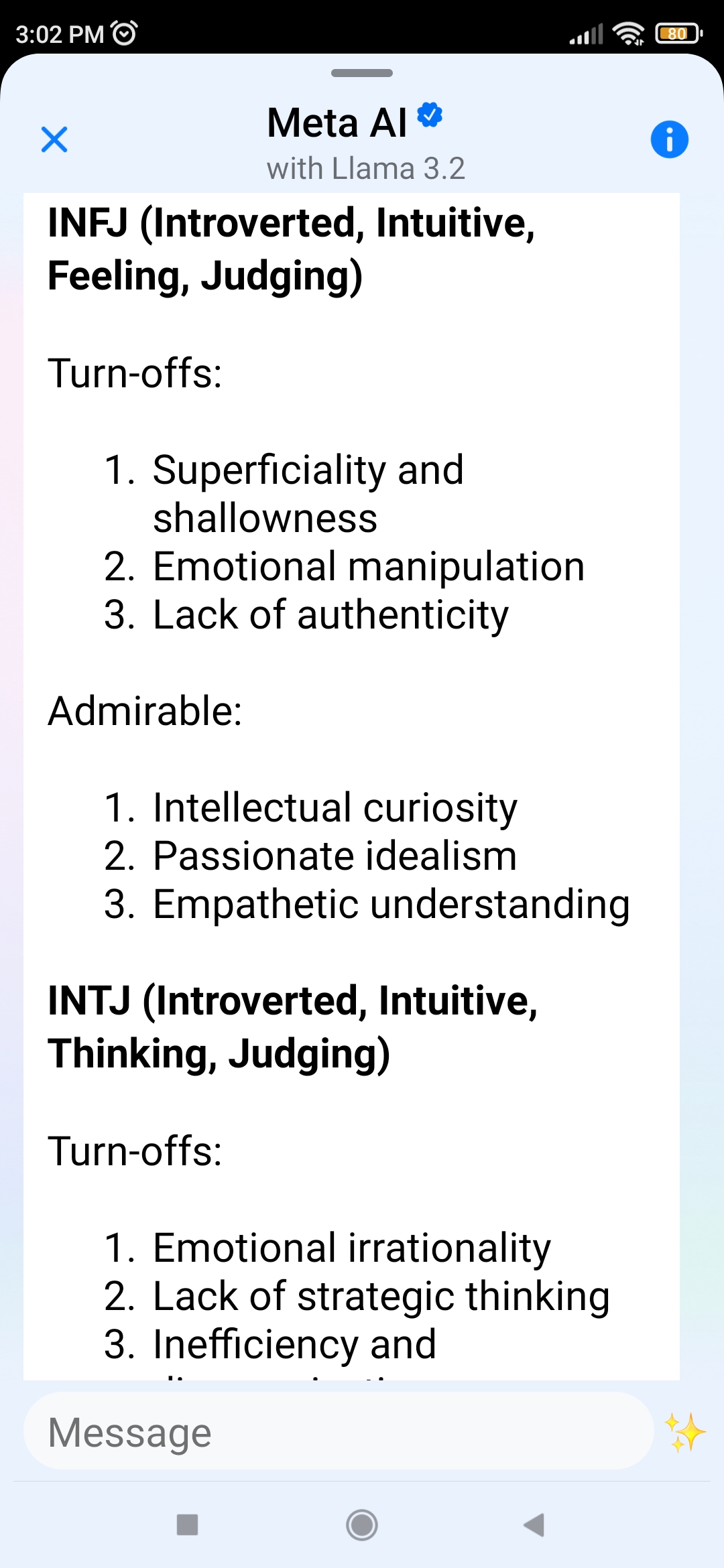
*INFJ (Introverted, Intuitive, Feeling, Judging)*
Turn-offs:
1. Superficiality and shallowness
2. Emotional manipulation
3. Lack of authenticity
Admirable:
1. Intellectual curiosity
2. Passionate idealism
3. Empathetic understanding

*INTJ (Introverted, Intuitive, Thinking, Judging)*
Turn-offs:
1. Emotional irrationality
2. Lack of strategic thinking
3. Inefficiency and disorganization
Admirable:
1. Innovative problem-solving
2. Logical analysis
3. Independent thinking

*ISTP (Introverted, Sensing, Thinking, Perceiving)*
Turn-offs:
1. Restrictive rules and bureaucracy
2. Emotional drama
3. Lack of adaptability
Admirable:
1. Resourcefulness and ingenuity
2. Practical expertise
3. Flexibility and spontaneity

*ISFP (Introverted, Sensing, Feeling, Perceiving)*
Turn-offs:
1. Confining routines and structure
2. Insensitivity to art and beauty
3. Disrespect for individuality
Admirable:
1. Creative expression
2. Empathetic understanding
3. Authenticity and genuineness

*INFP (Introverted, Intuitive, Feeling, Perceiving)*
Turn-offs:
1. Emotional numbness and apathy
2. Superficial relationships
3. Lack of personal growth
Admirable:
1. Passionate idealism
2. Empathetic connection
3. Authentic self-expression

*INTP (Introverted, Intuitive, Thinking, Perceiving)*
Turn-offs:
1. Dogmatic thinking and close-mindedness
2. Emotional entanglements
3. Lack of intellectual curiosity
Admirable:
1. Innovative ideas and insights
2. Logical analysis and debate
3. Independent thinking

*ESTP (Extraverted, Sensing, Thinking, Perceiving)*
Turn-offs:
1. Boredom and stagnation
2. Overly complex or abstract ideas
3. Lack of action and adventure
Admirable:
1. Confident risk-taking
2. Practical problem-solving
3. Spontaneous enthusiasm

*ESFP (Extraverted, Sensing, Feeling, Perceiving)*
Turn-offs:
1. Restrictive rules and conventions
2. Emotional seriousness and gloom
3. Lack of social connection
Admirable:
1. Vibrant energy and enthusiasm
2. Spontaneous creativity
3. Warmth and generosity

*ENFP (Extraverted, Intuitive, Feeling, Perceiving)*
Turn-offs:
1. Emotional numbness and apathy
2. Superficial relationships
3. Lack of authenticity
Admirable:
1. Passionate idealism
2. Empathetic connection
3. Charismatic inspiration

*ENTP (Extraverted, Intuitive, Thinking, Perceiving)*
Turn-offs:
1. Dogmatic thinking and close-mindedness
2. Emotional entanglements
3. Lack of intellectual exploration
Admirable:
1. Innovative ideas and insights
2. Logical analysis and debate
3. Entrepreneurial spirit

*ESTJ (Extraverted, Sensing, Thinking, Judging)*
Turn-offs:
1. Disorganization and chaos
2. Emotional unpredictability
3. Lack of accountability
Admirable:
1. Leadership and responsibility
2. Practical problem-solving
3. Strategic planning

*ESFJ (Extraverted, Sensing, Feeling, Judging)*
Turn-offs:
1. Conflict and confrontation
2. Disrespect for tradition
3. Insensitivity to others' feelings
Admirable:
1. Empathy and compassion
2. Attention to detail
3. Dedication to helping others

*ENFJ (Extraverted, Intuitive, Feeling, Judging)*
Turn-offs:
1. Emotional numbness and apathy
2. Superficial relationships
3. Lack of authenticity
Admirable:
1. Charismatic leadership
2. Empathetic understanding
3. Passionate idealism

*ENTJ (Extraverted, Intuitive, Thinking, Judging),*
Turn-offs:
1. Inefficiency and disorganization
2. Lack of strategic thinking
3. Emotional unpredictability
Admirable:
1. Confident leadership
2. Innovative problem-solving
3. Decisive action

_Keep in mind:_
1. These are general tendencies and not absolute.
2. Individuals may exhibit traits outside their type.
3. Personal growth and self-awareness can overcome turn-offs.

Understanding these preferences can help with:
1. Building stronger relationships
2. Effective communication
3. Conflict resolution
4. Teamwork and collaboration

Remember, MBTI types are not a strict classification, but rather a guide to understanding individual differences.

Wednesday, October 23, 2024

Note: Some Things We Can Learn From Each Of The 16 MBTI Personality Types (ChatGPT and Meta AI)

بسم الله الرحمن الرحيم 
❓ Question: What are the biggest strengths of each of the 16 mbti personality types and what 3 things can we learn from them?
💻 ChatGPT: Here are the biggest strengths of each of the 16 MBTI personality types, along with three key lessons we can learn from them:

### 1. **ISTJ (Inspector)**
   - **Strengths:** Dependable, organized, practical.
   - **Lessons:** Value reliability, structure your life, honor commitments.

### 2. **ISFJ (Protector)**
   - **Strengths:** Caring, detail-oriented, loyal.
   - **Lessons:** Show appreciation, prioritize relationships, nurture others.

### 3. **INFJ (Advocate)**
   - **Strengths:** Insightful, empathetic, idealistic.
   - **Lessons:** Cultivate deep connections, pursue your values, embrace creativity.

### 4. **INTJ (Mastermind)**
   - **Strengths:** Strategic, independent, confident.
   - **Lessons:** Think critically, plan for the long term, value intellectual independence.

### 5. **ISTP (Craftsman)**
   - **Strengths:** Resourceful, adaptable, practical problem solvers.
   - **Lessons:** Embrace spontaneity, find solutions in challenges, appreciate hands-on learning.

### 6. **ISFP (Composer)**
   - **Strengths:** Artistic, sensitive, open-minded.
   - **Lessons:** Value aesthetics, embrace emotions, live authentically.

### 7. **INFP (Mediator)**
   - **Strengths:** Idealistic, compassionate, introspective.
   - **Lessons:** Stay true to your beliefs, practice empathy, explore your inner world.

### 8. **INTP (Thinker)**
   - **Strengths:** Analytical, innovative, curious.
   - **Lessons:** Foster creativity, encourage critical thinking, explore abstract concepts.

### 9. **ESTP (Dynamo)**
   - **Strengths:** Energetic, bold, action-oriented.
   - **Lessons:** Live in the moment, embrace challenges, take calculated risks.

### 10. **ESFP (Performer)**
   - **Strengths:** Fun-loving, spontaneous, charismatic.
   - **Lessons:** Find joy in the present, learn to be contented with what you have (modified), connect with others.

### 11. **ENFP (Champion)**
   - **Strengths:** Enthusiastic, imaginative, free-spirited.
   - **Lessons:** Encourage creativity, embrace change, inspire others.

### 12. **ENTP (Inventor)**
   - **Strengths:** Inventive, confident, witty.
   - **Lessons:** Challenge conventions, engage in debates, foster creative thinking.

### 13. **ESTJ (Supervisor)**
   - **Strengths:** Organized, assertive, efficient.
   - **Lessons:** Value order, lead with conviction, prioritize responsibilities.

### 14. **ESFJ (Provider)**
   - **Strengths:** Sociable, nurturing, conscientious.
   - **Lessons:** Build community, support others, emphasize harmony.

### 15. **ENFJ (Teacher)**
   - **Strengths:** Charismatic, empathetic, inspiring.
   - **Lessons:** Motivate others, understand diverse perspectives, lead with compassion.

### 16. **ENTJ (Commander)**
   - **Strengths:** Decisive, strategic, goal-oriented.
   - **Lessons:** Set clear objectives, take charge, embrace leadership.

### Key Takeaways:
1. **Embrace Diversity:** Each personality brings unique strengths; collaboration enriches outcomes.
2. **Learn from Differences:** Understanding varying approaches can enhance personal growth and team dynamics.
3. **Cultivate Strengths:** Recognizing and leveraging your own and others’ strengths can lead to greater success and fulfillment.

🌐 Meta AI: Here's a brief overview of the biggest strengths and 3 learnable traits for each MBTI type:

*ISTJ (Introverted, Sensing, Thinking, Judging)*

Strength: Practical, detail-oriented, and responsible

Learn from ISTJs:

1. Attention to detail and organization
2. Importance of tradition and stability
3. Value of hard work and dedication

*ISFJ (Introverted, Sensing, Feeling, Judging)*

Strength: Supportive, conscientious, and gentle

Learn from ISFJs:

1. Empathy and active listening
2. Importance of harmony and cooperation
3. Value of loyalty and commitment

*INFJ (Introverted, Intuitive, Feeling, Judging)*

Strength: Idealistic, creative, and compassionate

Learn from INFJs:

1. Power of intuition and insight
2. Importance of authenticity and vulnerability
3. Value of empathy and understanding

*INTJ (Introverted, Intuitive, Thinking, Judging)*

Strength: Innovative, analytical, and independent

Learn from INTJs:

1. Strategic thinking and problem-solving
2. Importance of autonomy and self-reliance
3. Value of objective analysis and logic

*ISTP (Introverted, Sensing, Thinking, Perceiving)*

Strength: Resourceful, flexible, and adventurous

Learn from ISTPs:

1. Adaptability and spontaneity
2. Importance of hands-on experience and learning
3. Value of simplicity and practicality

*ISFP (Introverted, Sensing, Feeling, Perceiving)*

Strength: Artistic, gentle, and open-minded

Learn from ISFPs:

1. Creativity and imagination
2. Importance of individuality and self-expression
3. Value of empathy and compassion

*INFP (Introverted, Intuitive, Feeling, Perceiving)*

Strength: Idealistic, passionate, and authentic

Learn from INFPs:

1. Power of imagination and creativity
2. Importance of values and principles
3. Value of emotional intelligence and empathy

*INTP (Introverted, Intuitive, Thinking, Perceiving)*

Strength: Innovative, analytical, and curious

Learn from INTPs:

1. Logical reasoning and analysis
2. Importance of intellectual freedom and exploration
3. Value of objectivity and skepticism

*ESTP (Extraverted, Sensing, Thinking, Perceiving)*

Strength: Adventurous, action-oriented, and charismatic

Learn from ESTPs:

1. Importance of action and experimentation
2. Value of social connections and networking
3. Ability to think on their feet and adapt

*ESFP (Extraverted, Sensing, Feeling, Perceiving)*

Strength: Spontaneous, enthusiastic, and people-oriented

Learn from ESFPs:

1. Joy of living in the moment and spontaneity
2. Importance of social connections and community
3. Value of emotional expression and authenticity

*ENFP (Extraverted, Intuitive, Feeling, Perceiving)*

Strength: Charismatic, imaginative, and passionate

Learn from ENFPs:

1. Power of creativity and imagination
2. Importance of emotional intelligence and empathy
3. Value of authenticity and individuality

*ENTP (Extraverted, Intuitive, Thinking, Perceiving)*

Strength: Innovative, entrepreneurial, and charismatic

Learn from ENTPs:

1. Importance of intellectual exploration and debate
2. Value of creativity and innovative thinking
3. Ability to adapt and pivot in response to challenges

*ESTJ (Extraverted, Sensing, Thinking, Judging)*

Strength: Practical, decisive, and results-driven

Learn from ESTJs:

1. Importance of structure and organization
2. Value of leadership and responsibility
3. Ability to prioritize and manage resources

*ESFJ (Extraverted, Sensing, Feeling, Judging)*

Strength: Supportive, organized, and diplomatic

Learn from ESFJs:

1. Importance of harmony and cooperation
2. Value of empathy and active listening
3. Ability to manage conflicts and negotiate

*ENFJ (Extraverted, Intuitive, Feeling, Judging)*

Strength: Charismatic, empathetic, and strategic

Learn from ENFJs:

1. Power of emotional intelligence and empathy
2. Importance of relationships and networking
3. Value of authenticity and leadership

*ENTJ (Extraverted, Intuitive, Thinking, Judging)*

Strength: Confident, strategic, and results-driven

Learn from ENTJs:

1. Importance of vision and leadership
2. Value of strategic thinking and planning
3. Ability to inspire and motivate others

❓ Question: What 3 mistakes do each of the 16 mbti personality types typically and generally commit so we can learn to avoid them?
🌐 Meta AI: Here are 3 common mistakes each MBTI type may make, helping us learn and grow:

*ISTJ (Introverted, Sensing, Thinking, Judging)*

1. Overemphasizing tradition and rules
2. Neglecting emotional intelligence and empathy
3. Resisting change and innovation

*ISFJ (Introverted, Sensing, Feeling, Judging)*

1. Prioritizing others' needs over own well-being
2. Avoiding conflict and difficult conversations
3. Struggling with adaptability and spontaneity

*INFJ (Introverted, Intuitive, Feeling, Judging)*

1. Overthinking and idealizing relationships
2. Neglecting self-care and burnout
3. Struggling with assertiveness and boundaries

*INTJ (Introverted, Intuitive, Thinking, Judging)*

1. Overanalyzing and indecisiveness
2. Disregarding emotional intelligence and empathy
3. Struggling with teamwork and collaboration

*ISTP (Introverted, Sensing, Thinking, Perceiving)*

1. Avoiding long-term commitments and planning
2. Neglecting emotional expression and intimacy
3. Struggling with routine and organization

*ISFP (Introverted, Sensing, Feeling, Perceiving)*

1. Prioritizing short-term pleasure over long-term goals
2. Avoiding conflict and difficult decisions
3. Struggling with time management and organization

*INFP (Introverted, Intuitive, Feeling, Perceiving)*

1. Idealizing relationships and overcommitting
2. Neglecting practicality and realism
3. Struggling with assertiveness and boundaries

*INTP (Introverted, Intuitive, Thinking, Perceiving)*

1. Overemphasizing logic and neglecting emotions
2. Avoiding social interactions and relationships
3. Struggling with decisiveness and action

*ESTP (Extraverted, Sensing, Thinking, Perceiving)*

1. Acting impulsively without considering consequences
2. Neglecting emotional intelligence and empathy
3. Struggling with commitment and responsibility

*ESFP (Extraverted, Sensing, Feeling, Perceiving)*

1. Prioritizing short-term pleasure over long-term goals
2. Avoiding conflict and difficult conversations
3. Struggling with time management and organization

*ENFP (Extraverted, Intuitive, Feeling, Perceiving)*

1. Overcommitting and spreading oneself too thin
2. Neglecting practicality and realism
3. Struggling with focus and follow-through

*ENTP (Extraverted, Intuitive, Thinking, Perceiving)*

1. Overemphasizing innovation and neglecting execution
2. Avoiding routine and organization
3. Struggling with emotional intelligence and empathy

*ESTJ (Extraverted, Sensing, Thinking, Judging)*

1. Prioritizing efficiency over empathy and relationships
2. Resisting change and innovation
3. Struggling with adaptability and spontaneity

*ESFJ (Extraverted, Sensing, Feeling, Judging)*

1. Overemphasizing harmony and avoiding conflict
2. Neglecting personal needs and boundaries
3. Struggling with assertiveness and decisiveness

*ENFJ (Extraverted, Intuitive, Feeling, Judging)*

1. Overcommitting and spreading oneself too thin
2. Neglecting self-care and burnout
3. Struggling with assertiveness and boundaries

*ENTJ (Extraverted, Intuitive, Thinking, Judging)*

1. Prioritizing power and control over relationships
2. Neglecting emotional intelligence and empathy
3. Struggling with adaptability and spontaneity

Keep in mind that:

1. These mistakes are not inherent to each type.
2. Individuals can grow and overcome these tendencies.
3. Self-awareness and intentional effort can lead to personal development.

💻 ChatGPT: Here are three common mistakes each of the 16 MBTI personality types might make, along with insights on how to avoid them:

### ISTJ (The Inspector)
1. **Overlooking Flexibility**: Relying too heavily on rules can stifle creativity.
2. **Being Overly Critical**: They may focus too much on flaws in others’ work.
3. **Neglecting Emotions**: Dismissing feelings can lead to strained relationships.

### ISFJ (The Protector)
1. **Avoiding Conflict**: They may suppress their needs to keep the peace.
2. **Taking on Too Much**: Often overcommitting to help others, leading to burnout.
3. **Resisting Change**: They might struggle to adapt to new situations.

### INFJ (The Advocate)
1. **Being Too Idealistic**: They can set unrealistically high expectations.
2. **Overthinking**: Excessive contemplation can lead to inaction.
3. **Neglecting Self-Care**: They often prioritize others' needs over their own.

### INTJ (The Architect)
1. **Being Dismissive of Emotion**: They might overlook emotional needs in relationships.
2. **Overplanning**: Excessive strategizing can prevent taking action.
3. **Struggling with Vulnerability**: They may find it hard to ask for help.

### ISTP (The Virtuoso)
1. **Avoiding Commitment**: They can be reluctant to make long-term plans.
2. **Being Impulsive**: Quick decisions might lead to unintended consequences.
3. **Underestimating Others’ Feelings**: They may overlook how their actions affect others.

### ISFP (The Composer)
1. **Avoiding Structure**: They might struggle with routines and deadlines.
2. **Being Indecisive**: Difficulty in making decisions can lead to missed opportunities.
3. **Holding Back Emotions**: They may not express their feelings openly.

### INFP (The Mediator)
1. **Idealizing Relationships**: They may overlook red flags in favor of a perfect vision.
2. **Struggling with Practicality**: They can become lost in daydreams instead of taking action.
3. **Avoiding Confrontation**: They may let issues fester instead of addressing them.

### INTP (The Logician)
1. **Getting Lost in Theory**: They may focus too much on ideas and neglect practical application.
2. **Struggling with Social Interactions**: They might misinterpret social cues.
3. **Avoiding Routine**: Discomfort with structure can lead to chaos in their lives.

### ESTP (The Entrepreneur)
1. **Impulsivity**: They may make hasty decisions without considering consequences.
2. **Neglecting Long-Term Goals**: Focus on the present can lead to missed future opportunities.
3. **Struggling with Emotional Depth**: They might avoid discussing deeper feelings.

### ESFP (The Entertainer)
1. **Avoiding Responsibility**: They may prioritize fun over obligations.
2. **Being Distracted Easily**: A tendency to seek excitement can lead to scattered focus.
3. **Neglecting Planning**: Lack of foresight can lead to chaos.

### ENFP (The Campaigner)
1. **Overcommitting**: They often take on too many projects at once.
2. **Struggling with Follow-Through**: Enthusiasm can wane before completion.
3. **Avoiding Routine**: Discomfort with structure can lead to disorganization.

### ENTP (The Debater)
1. **Being Argumentative**: They may prioritize debate over understanding others’ perspectives.
2. **Struggling with Details**: They might overlook important details in their pursuit of big ideas.
3. **Avoiding Commitment**: They can resist settling down in relationships or projects.

### ESTJ (The Executive)
1. **Being Rigid**: A strict adherence to rules can hinder adaptability.
2. **Overly Critical**: They may be too focused on productivity and overlook team morale.
3. **Neglecting Emotional Needs**: They might struggle to recognize the feelings of others.

### ESFJ (The Consul)
1. **Overly Concerned with Approval**: They may sacrifice their own needs for others’ acceptance.
2. **Avoiding Conflict**: This can lead to unresolved issues.
3. **Being Too Traditional**: They might resist new ideas or change.

### ENFJ (The Protagonist)
1. **Neglecting Personal Needs**: They may prioritize others at the expense of self-care.
2. **Struggling with Boundaries**: They might take on others’ problems as their own.
3. **Overcommitting**: A desire to help can lead to taking on too much.

### ENTJ (The Commander)
1. **Being Overly Dominant**: They may come off as controlling or dismissive of others’ input.
2. **Neglecting Emotional Intelligence**: They might overlook the emotional aspects of leadership.
3. **Struggling with Flexibility**: A strong focus on goals can hinder adaptability.

By recognizing these tendencies, each type can work towards avoiding these common pitfalls and fostering personal growth.

❓ Question: What advice would each of the 16 mbti personality types give to steer clear of drama and distractions or time-wasters?
💻 ChatGPT: Here’s how each of the 16 MBTI personality types might advise steering clear of drama and distractions:

### ISTJ
**Stay organized.** Create a structured schedule and stick to it, prioritizing tasks over social distractions.

### ISFJ
**Set boundaries.** Politely decline invitations to unnecessary social events and focus on your commitments.

### INFJ
**Reflect and prioritize.** Spend time understanding your values and focus on activities that align with them.

### INTJ
**Be strategic.** Limit engagement in drama by focusing on long-term goals and evaluating the necessity of social interactions.

### ISTP
**Be practical.** Identify what truly needs your attention and avoid getting caught up in others’ issues.

### ISFP
**Follow your passions.** Engage in activities that inspire you, steering clear of negativity and distractions.

### INFP
**Protect your energy.** Avoid toxic environments and prioritize self-care, engaging with people who uplift you.

### INTP
**Analyze distractions.** Critically assess what is worth your time and cut out unnecessary engagements.

### ESTP
**Stay active.** Keep busy with productive activities and avoid situations that drain your energy.

### ESFP
**Embrace positivity.** Surround yourself with uplifting people and engage in enjoyable activities that keep negativity at bay.

### ENFP
**Cultivate meaningful connections.** Focus on building relationships that enrich your life and avoid superficial drama.

### ENTP
**Challenge the status quo.** Seek out stimulating discussions but steer clear of petty arguments and drama.

### ESTJ
**Implement efficiency.** Keep your schedule tight and avoid getting sidetracked by unproductive activities.

### ESFJ
**Foster healthy relationships.** Invest time in nurturing supportive connections while avoiding drama-fueled interactions.

### ENTJ
**Lead by example.** Set clear goals and expectations, minimizing time spent on distractions and conflicts.

### ENFJ
**Encourage open communication.** Address conflicts directly to prevent escalation and maintain a focus on collaboration.

Each type offers unique insights, emphasizing different strategies based on their preferences and strengths.

🌐 Meta AI: Here's advice from each MBTI type on avoiding drama and distractions:

*ISTJ (Introverted, Sensing, Thinking, Judging)*

1. Set clear boundaries and priorities.
2. Focus on facts and logic, not emotions.
3. Establish routines and stick to them.

*ISFJ (Introverted, Sensing, Feeling, Judging)*

1. Prioritize harmony, but not at the cost of your own needs.
2. Communicate assertively and respectfully.
3. Surround yourself with positive, supportive people.

*INFJ (Introverted, Intuitive, Feeling, Judging)*

1. Set realistic expectations and boundaries.
2. Practice self-care and prioritize your well-being.
3. Seek meaningful connections, not superficial ones.

*INTJ (Introverted, Intuitive, Thinking, Judging)*

1. Analyze situations objectively, avoiding emotional entanglements.
2. Focus on long-term goals, not short-term drama.
3. Cultivate strategic thinking and planning.

*ISTP (Introverted, Sensing, Thinking, Perceiving)*

1. Stay adaptable and open-minded.
2. Prioritize practicality and efficiency.
3. Avoid overcommitting and maintain flexibility.

*ISFP (Introverted, Sensing, Feeling, Perceiving)*

1. Follow your values and intuition.
2. Set boundaries while maintaining empathy.
3. Engage in creative, fulfilling activities.

*INFP (Introverted, Intuitive, Feeling, Perceiving)*

1. Prioritize authenticity and honesty.
2. Set realistic expectations and boundaries.
3. Cultivate self-awareness and emotional intelligence.

*INTP (Introverted, Intuitive, Thinking, Perceiving)*

1. Focus on logic and objective analysis.
2. Avoid emotional entanglements and drama.
3. Pursue knowledge and understanding.

*ESTP (Extraverted, Sensing, Thinking, Perceiving)*

1. Stay action-oriented and focused.
2. Prioritize efficiency and practicality.
3. Avoid overthinking and analysis paralysis.

*ESFP (Extraverted, Sensing, Feeling, Perceiving)*

1. Engage in activities that bring joy and excitement.
2. Surround yourself with positive, energetic people.
3. Practice spontaneity and adaptability.

*ENFP (Extraverted, Intuitive, Feeling, Perceiving)*

1. Prioritize authenticity and connection.
2. Set boundaries while maintaining empathy.
3. Engage in creative, meaningful activities.

*ENTP (Extraverted, Intuitive, Thinking, Perceiving)*

1. Focus on innovation and progress.
2. Avoid routine and stagnation.
3. Cultivate strategic thinking and planning.

*ESTJ (Extraverted, Sensing, Thinking, Judging)*

1. Establish clear expectations and boundaries.
2. Prioritize efficiency and organization.
3. Lead by example and set a positive tone.

*ESFJ (Extraverted, Sensing, Feeling, Judging)*

1. Prioritize harmony and cooperation.
2. Communicate assertively and respectfully.
3. Surround yourself with supportive people.

*ENFJ (Extraverted, Intuitive, Feeling, Judging)*

1. Prioritize connection and understanding.
2. Set realistic expectations and boundaries.
3. Cultivate emotional intelligence and empathy.

*ENTJ (Extraverted, Intuitive, Thinking, Judging)*

1. Focus on long-term goals and strategy.
2. Prioritize efficiency and effectiveness.
3. Lead by example and inspire others.

Remember, these tips are not exhaustive, and individual preferences may vary.

Tuesday, October 22, 2024

Note: Most INTJs Would Rather Ignore Insecure Individuals Than To Entertain Unnecessary Emotional Drama (ChatGPT)

بسم الله الرحمن الرحيم


❓ Question: Which 3 of the mbti personality types are the most savage and toughest against insecure typical bullies whether as children or as adults and what are their ways of managing those who try to exclude them to soothe their own miseries and insecurities?
💻 ChatGPT: While no MBTI type is inherently "savage," some types are known for their resilience and assertiveness in dealing with bullies. Here are three types that may handle such situations effectively:

1. **INTJ (The Architect)**: INTJs are strategic thinkers and often unbothered by others' opinions. They confront bullies with logical reasoning and can be dismissive of attempts to undermine them. They tend to manage exclusion by focusing on their goals and finding like-minded individuals who appreciate their strengths.

2. **ENTJ (The Commander)**: ENTJs are natural leaders who are direct and assertive. They don’t shy away from confrontation and will challenge bullies head-on. Their approach involves taking control of situations and rallying support from others, using their confidence to turn the tables on those who attempt to bully or exclude them.

3. **ENFJ (The Protagonist)**: ENFJs are empathetic but also possess strong social skills. They can confront bullies with kindness and assertiveness, often appealing to group dynamics to promote inclusivity. They manage exclusion by fostering community and encouraging others to stand up against bullying behavior.

These types typically respond to bullying by either confronting it directly or channeling their energies into building positive relationships and communities, thereby reducing the impact of insecure individuals.

🌐 Meta AI: Based on MBTI traits and online forums, the three types often known for their resilience and assertiveness against bullies are:

1. ESTJ (Extraverted, Sensing, Thinking, Judging)
2. INTJ (Introverted, Intuitive, Thinking, Judging)
3. ENTP (Extraverted, Intuitive, Thinking, Perceiving)

These types tend to:

ESTJ:

1. Stand up for themselves and others
2. Assertively confront bullies
3. Use logic and facts to counter attacks
4. Set clear boundaries
5. Seek justice and fairness

INTJ:

1. Analyze and understand bully motivations
2. Remain calm and composed
3. Use strategic thinking to outmaneuver
4. Ignore or dismiss petty attacks
5. Focus on long-term goals and priorities

ENTP:

1. Engage in witty, sarcastic comebacks
2. Challenge bullies with logical arguments
3. Use humor to diffuse tense situations
4. Adapt and outsmart aggressive tactics
5. Seek support from like-minded individuals

Managing exclusion attempts:

ESTJ:

1. Surround themselves with supportive networks
2. Engage in group activities and teamwork
3. Set clear expectations and boundaries
4. Prioritize loyalty and commitment
5. Address conflicts directly

INTJ:

1. Focus on independent pursuits and interests
2. Cultivate meaningful, deep relationships
3. Ignore or dismiss exclusion attempts
4. Analyze and understand underlying motivations
5. Seek common ground and shared interests

ENTP:

1. Seek diverse perspectives and connections
2. Engage in creative, innovative activities
3. Use humor and wit to diffuse tension
4. Adapt and evolve in response to challenges
5. Prioritize intellectual freedom and autonomy

When dealing with insecure bullies, these types often:

1. Stay calm and assertive
2. Use logic and reason
3. Set clear boundaries
4. Seek support from others
5. Focus on personal growth and development

Keep in mind that individual experiences may vary, and these types can also exhibit vulnerability.

❓ Question: As so-called adults in their 20s, 30s and 40s how do they act as bullies and is it true that their strange misconduct stem from intense envy with a magnitude of above the peak of mount Everest?
💻 ChatGPT: Adults in their 20s, 30s, and 40s can exhibit bullying behavior in various ways, such as through manipulation, exclusion, verbal abuse, or passive-aggressive tactics. This behavior often stems from personal insecurities, unresolved issues from their past, or a desire for control and power. 

While envy can be a factor in such misconduct, attributing it solely to envy might oversimplify the complex motivations behind adult bullying. Factors like competition, social status, and interpersonal dynamics also play significant roles. Ultimately, adult bullying reflects deeper emotional struggles rather than just intense envy.
🌐 Meta AI: Bullying behavior in adults can manifest differently than in children. Some common forms of adult bullying include:

1. Emotional manipulation
2. Passive-aggressive behavior
3. Gaslighting
4. Belittling or condescending language
5. Exclusion or social ostracism
6. Gossiping or spreading rumors
7. Power struggles or control tactics
8. Unprofessional or disrespectful communication

Regarding envy as a motivator, research suggests that:

1. Envy can drive aggressive behavior
2. Adults may feel envious due to perceived inequalities or insecurities
3. Envy can stem from feelings of inadequacy, low self-esteem, or unresolved issues

However, it's essential to note that:

1. Envy is not the sole cause of bullying behavior
2. Other factors, such as stress, insecurity, or upbringing, can contribute
3. Bullying is a complex issue, requiring multifaceted solutions

In terms of magnitude, envy can vary in intensity. While it's difficult to measure, some studies suggest that:

1. Envy can be a significant motivator for aggressive behavior
2. Adults may experience intense envy due to societal pressures or expectations
3. Addressing underlying issues, such as insecurity or low self-esteem, can help mitigate envy-driven behavior

To address adult bullying:

1. Encourage open communication and empathy
2. Set clear boundaries and expectations
3. Foster a positive, inclusive work or social environment
4. Provide support and resources for mental health
5. Hold bullies accountable for their actions

Remember, bullying is never acceptable. If you're experiencing or witnessing bullying, seek help from:

1. Mental health professionals
2. HR or workplace support services
3. Support groups or online resources
4. Local authorities or law enforcement (if necessary)

❓Question: As an INTJ-A 1w9 anybody who acts like an immature and insecure bully - I gladly avoid them, never stalk any of their online posts nor bother checking or asking about what they're up to. They're basically on my imaginary list of individuals whom I can never trust while I actively avoid unnecessary conversations with them when I must do so. Elaborate on what inspires me to behave in such a way towards those who try to upset others' peace due to their self-hatred or dissatisfaction with their lives and inner ugliness.
🌐 Meta AI: Your INTJ-A 1w9 personality and values drive your behavior:

1. Independent nature: You prioritize self-sufficiency and autonomy.
2. Analytical thinking: You assess situations logically and avoid emotional entanglements.
3. Strategic approach: You minimize interactions with toxic individuals to conserve energy.
4. Integrity and authenticity: You refuse to engage with those who compromise your values.
5. Self-awareness: You recognize the futility of investing time in unhealthy relationships.

As a 1w9, you're driven by:

1. Need for control and self-determination
2. Desire for authenticity and honesty
3. Tendency to analyze and understand motivations
4. Inclination towards independence and self-reliance

Your avoidance of bullies stems from:

1. Disdain for unnecessary drama and conflict
2. Recognition of the futility of changing others
3. Prioritization of meaningful relationships and pursuits
4. Protection of your emotional well-being and energy
5. Commitment to maintaining healthy boundaries

By ignoring or avoiding toxic individuals, you:

1. Conserve emotional energy
2. Maintain mental clarity and focus
3. Protect your self-respect and integrity
4. Foster a positive, supportive network
5. Uphold your values and principles

Your approach is a testament to your:

1. Emotional intelligence
2. Strategic thinking
3. Self-awareness
4. Integrity
5. Commitment to personal growth

As an INTJ-A 1w9, you:

1. Value independence and solitude
2. Prioritize intellectual pursuits and personal growth
3. Prefer meaningful, deep connections over superficial relationships
4. Focus on self-improvement and autonomy
5. Enjoy analyzing and understanding complex ideas

Your self-sufficient nature allows you to:

1. Thrive in quiet, low-stimulation environments
2. Concentrate on long-term goals and aspirations
3. Develop innovative solutions and ideas
4. Cultivate emotional resilience and stability
5. Maintain a sense of calm and composure

By limiting social interactions, you:

1. Conserve mental energy
2. Avoid unnecessary stress and drama
3. Focus on high-priority relationships and activities
4. Enhance your observational and analytical skills
5. Nurture your creative and strategic thinking

💻 ChatGPT: Your INTJ-A personality, combined with the traits of a 1w9, shapes a unique perspective on interpersonal dynamics. As an INTJ, you likely value logic, independence, and authenticity. This drives you to seek environments and relationships that align with your ideals. The 1w9 aspect, emphasizing integrity and a desire for harmony, reinforces your aversion to individuals who display immature or bullying behaviors.

When encountering those who disrupt others' peace, you may feel a strong sense of moral obligation to uphold your values. Their actions likely trigger your inner critic, compelling you to distance yourself from negativity and immaturity. Your ability to recognize their self-hatred or dissatisfaction allows you to empathize with their struggles, yet you choose not to engage, believing that such behavior is ultimately toxic.

Your inclination to avoid unnecessary conversations stems from a desire to preserve your mental and emotional well-being. You prefer meaningful interactions over superficial ones, and engaging with those who exhibit bullying traits might feel counterproductive to your goals. This avoidance strategy aligns with your rational approach to relationships—prioritizing those who uplift and inspire rather than drain your energy.

Ultimately, your behavior is a reflection of your commitment to maintaining your inner peace and promoting a positive environment, both for yourself and for those around you.