بسم الله. ربي زدني علما. امين

بسم الله. ربي زدني علما. امين
May Allah the Almighty grant us more beneficial knowledge, accept our good deeds, forgive our mistakes, protect us from fitna, and join us with the righteous believers in Jannatul Ferdaus. Ameen.

Tuesday, August 13, 2024

Tips: Some Tips From ChatGPT On Tidying Up And Decluttering

بسم الله الرحمن الرحيم

Question: Give as many tips and advice for someone to feel motivated to efficiently and quickly declutter and discard things they may not use in a long time.

ChatGPT: Certainly! Here are some tips and advice to help you stay motivated and efficiently declutter and discard items you don't need:

1. **Set Clear Goals**: Define what you want to achieve with decluttering. Whether it's creating a more organized space or preparing for a move, having specific goals can guide your efforts.

2. **Start Small**: Tackle one area or category at a time, such as a single drawer or a section of a closet, to avoid feeling overwhelmed.

3. **Use the "Four-Box Method"**: Label four boxes or bags as "Keep," "Donate/Sell," "Recycle," and "Trash." As you sort through items, place them into the appropriate box.

4. **Apply the "One-Year Rule"**: If you haven’t used an item in the past year, consider if you really need to keep it. This rule helps in making decisions about items that haven’t been used recently.

5. **Set a Timer**: Use a timer to work in short bursts, such as 20-30 minutes, to maintain focus and prevent burnout. Take a break after each session.

6. **Visualize the End Result**: Imagine the benefits of a decluttered space, such as reduced stress, more space, or a more organized home. This can keep you motivated.

7. **Ask for Help**: Involve friends or family members who can offer support, encouragement, or a fresh perspective on what to keep or discard.

8. **Use the "Five-Second Rule"**: When deciding whether to keep an item, make a decision within five seconds to avoid overthinking and hesitation.

9. **Celebrate Small Wins**: Acknowledge and reward yourself after completing each area or task. Small rewards can keep you motivated throughout the process.

10. **Document Progress**: Take before-and-after photos of areas you’ve decluttered. Seeing your progress can be motivating and satisfying.

11. **Stay Disciplined**: Remind yourself of the reasons why you're decluttering and keep those reasons at the forefront of your mind to stay on track.

12. **Create a Decluttering Playlist**: Listen to some Qur'an recitation, lectures, motivational talks or beneficial podcasts while working to make the process more enjoyable and engaging. Or say Du'a and Adhkaar while tidying up.

13. **Establish a Routine**: Set a regular time for decluttering sessions, even if they’re brief. Consistency can make the task feel more manageable.

14. **Consider the Impact**: Think about the positive impact your decluttering will have, such as donating items to those in need or creating a more functional space for yourself.

15. **Get Rid of Duplicates**: If you find multiple items of the same type (e.g., pens, kitchen utensils), keep only the ones you use regularly and discard the rest.

By applying these tips, you can make the decluttering process more efficient and less daunting.

🌼
Question: Without requiring assistance from people.

ChatGPT: Sure, here are some strategies to declutter efficiently on your own (with Allah's Will and Guidance):

1. **Set Specific Goals**: Define what you want Inn-sha-Allah to achieve in each session, such as clearing out a specific drawer or closet.

2. **Create a Schedule**: Plan dedicated times for decluttering in your calendar. Consistency helps build a routine.

3. **Use the "Three-Box Method"**: Separate items into "Keep," "Donate/Sell," and "Trash" boxes to simplify the sorting process.

4. **Apply the "One-Year Rule"**: If you haven’t used an item in the past year, decide whether it’s worth keeping.

5. **Utilize Timed Sessions**: Set a timer for 20-30 minutes to stay focused and avoid feeling overwhelmed.

6. **Take Before-and-After Photos**: Documenting your progress can be motivating and help you see how much you’ve accomplished.

7. **Implement the "Five-Second Rule"**: Quickly decide whether to keep or discard an item to avoid overthinking.

8. **Use a Decluttering Checklist**: Create a list of areas or categories to tackle, helping you stay organized and track your progress.

9. **Visualize the Benefits**: Keep in mind the advantages of a decluttered space, such as increased organization and reduced stress.

10. **Reward Yourself**: Treat yourself after completing a task or area to maintain motivation.

11. **Sort Items by Category**: Instead of focusing on one room, sort items by category (clothing, books, kitchenware) to streamline the process.

12. **Apply the "Touch It Once" Rule**: Handle each item only once to make quick decisions about where it should go.

13. **Create a Decluttering Playlist**: Listen to some Qur'an recitations or lectures to make the process more engaging. (Avoid listening to music as much as possible)

14. **Use Storage Solutions**: Invest in storage containers or organizers to help keep what you decide to keep more manageable and tidy.

15. **Reflect on Your Progress**: Regularly review what you’ve accomplished to stay motivated and maintain momentum.

By following these tips, you can 
Inn-sha-Allah effectively manage decluttering on your own and make the process more manageable.
⤴️ Some notes from ChatGPT

...a breakdown of how each MBTI type from the 16 MBTI personality types may struggle with and excel at decluttering and organizing:

### **1. ISTJ (Introverted, Sensing, Thinking, Judging)**
- **Struggles:**
  - Over-focusing on details and perfection.
  - Difficulty letting go of items due to their perceived value or utility.
  - Procrastination if the task feels overwhelming or lacks clear structure.

- **Strengths:**
  - Creating efficient and methodical systems for organization.
  - Sticking to a plan and seeing tasks through to completion.
  - Keeping track of items and ensuring everything has its place.

### **2. ISFJ (Introverted, Sensing, Feeling, Judging)**
- **Struggles:**
  - Sentimental attachment to items, making it hard to declutter.
  - Overwhelmed by the emotional aspect of letting go of possessions.
  - Difficulty in prioritizing tasks if they feel overwhelmed by others’ needs.

- **Strengths:**
  - Creating organized and aesthetically pleasing spaces.
  - Attending to details and ensuring items are stored with care.
  - Being thorough and methodical in their approach.

### **3. INFJ (Introverted, Intuitive, Feeling, Judging)**
- **Struggles:**
  - Struggling with clutter due to idealism and reluctance to confront the mess.
  - Overthinking the best way to organize, leading to inaction.
  - Feeling overwhelmed by the emotional aspect of decluttering.

- **Strengths:**
  - Creating thoughtful and meaningful organization systems.
  - Being proactive in planning and setting long-term goals for organization.
  - Considering how the space affects overall well-being.

### **4. INTJ (Introverted, Intuitive, Thinking, Judging)**
- **Struggles:**
  - Dislike of routine tasks and details, potentially leading to neglect.
  - Difficulty in maintaining motivation for repetitive organizing tasks.
  - Potential frustration with lack of efficiency in the decluttering process.

- **Strengths:**
  - Designing efficient and strategic systems for organization.
  - Analyzing and implementing improvements for clutter control.
  - Setting and achieving long-term organizational goals.

### **5. ISTP (Introverted, Sensing, Thinking, Perceiving)**
- **Struggles:**
  - Disinterest in repetitive or mundane organizational tasks.
  - Struggling to maintain organization over time.
  - Tendency to keep items in disarray if not immediately useful.

- **Strengths:**
  - Quick and practical solutions to organize spaces.
  - Ability to adapt and reorganize as needed.
  - Efficiently handling tools and materials in a clutter-free manner.

### **6. ISFP (Introverted, Sensing, Feeling, Perceiving)**
- **Struggles:**
  - Overwhelmed by the emotional weight of letting go of items.
  - Difficulty in sticking to a structured plan for decluttering.
  - Disinterest in maintaining a rigid organizational system.

- **Strengths:**
  - Creating aesthetically pleasing and personalized spaces.
  - Organizing items in a way that reflects personal values and style.
  - Flexibly adapting organization methods to fit their changing needs.

### **7. INFP (Introverted, Intuitive, Feeling, Perceiving)**
- **Struggles:**
  - Difficulty letting go of items due to sentimental value.
  - Overwhelmed by the emotional impact of decluttering.
  - Procrastination or lack of follow-through on organizational tasks.

- **Strengths:**
  - Designing creative and meaningful organizational systems.
  - Understanding the emotional significance of items and organizing accordingly.
  - Creating spaces that reflect personal values and aesthetics.

### **8. INTP (Introverted, Intuitive, Thinking, Perceiving)**
- **Struggles:**
  - Disinterest in the routine aspects of cleaning and organizing.
  - Difficulty in maintaining a consistent organizational system.
  - Tendency to get lost in theoretical improvements without practical application.

- **Strengths:**
  - Innovative solutions for organizing and decluttering.
  - Analytical approach to understanding and improving organization systems.
  - Flexibility and adaptability in managing clutter.

### **9. ESTP (Extraverted, Sensing, Thinking, Perceiving)**
- **Struggles:**
  - Disinterest in maintaining a long-term organizational system.
  - Potential for quick fixes that don’t address underlying issues.
  - Difficulty focusing on detail-oriented tasks.

- **Strengths:**
  - Practical and efficient approaches to decluttering.
  - Quick decision-making and action-taking.
  - Ability to handle physical aspects of cleaning and organizing effectively.

### **10. ESFP (Extraverted, Sensing, Feeling, Perceiving)**
- **Struggles:**
  - Difficulty with maintaining a structured organization system.
  - Tendency to get distracted from the task at hand.
  - Overwhelmed by the monotony of repetitive cleaning tasks.

- **Strengths:**
  - Creating vibrant and appealing spaces.
  - Energetic and hands-on approach to organizing.
  - Flexibility in adapting organization methods to their lifestyle.

### **11. ENFP (Extraverted, Intuitive, Feeling, Perceiving)**
- **Struggles:**
  - Difficulty in maintaining long-term organization and order.
  - Overwhelmed by the scope of decluttering tasks.
  - Tendency to start organizing projects without completing them.

- **Strengths:**
  - Creative and innovative approaches to organizing.
  - Designing spaces that are engaging and reflect personal interests.
  - Enthusiasm and energy in initiating organizational projects.

### **12. ENTP (Extraverted, Intuitive, Thinking, Perceiving)**
- **Struggles:**
  - Disinterest in maintaining detailed or long-term organization.
  - Tendency to get sidetracked by new ideas or projects.
  - Difficulty sticking to a single organizational system.

- **Strengths:**
  - Innovative solutions and creative approaches to decluttering.
  - Ability to adapt and experiment with different organizational methods.
  - Efficiently tackling clutter with a practical, problem-solving mindset.

### **13. ESTJ (Extraverted, Sensing, Thinking, Judging)**
- **Struggles:**
  - Frustration with tasks that don’t fit into their organizational system.
  - Difficulty dealing with sentimental items that don’t align with their logic.
  - Potential for impatience with slower, more methodical tasks.

- **Strengths:**
  - Implementing and enforcing systematic organization plans.
  - Ensuring efficiency and order in organizing and cleaning.
  - Being decisive and effective in managing clutter.

### **14. ESFJ (Extraverted, Sensing, Feeling, Judging)**
- **Struggles:**
  - Sentimental attachment to items that complicates decluttering.
  - Difficulty in prioritizing tasks when it affects others.
  - Overwhelmed by the scope of decluttering if not approached step-by-step.

- **Strengths:**
  - Creating organized and aesthetically pleasing spaces.
  - Paying attention to detail and ensuring everything is in its place.
  - Organizing with consideration for how the space serves others.

### **15. ENFJ (Extraverted, Intuitive, Feeling, Judging)**
- **Struggles:**
  - Overwhelmed by the emotional impact of decluttering.
  - Difficulty focusing on their own organizational needs if helping others.
  - Potential for overcomplicating organizational systems with a focus on ideal outcomes.

- **Strengths:**
  - Designing well-organized and functional spaces.
  - Creating an environment that supports the well-being of others.
  - Proactive and strategic in managing and improving organization.

### **16. ENTJ (Extraverted, Intuitive, Thinking, Judging)**
- **Struggles:**
  - Frustration with slow or inefficient organizing processes.
  - Difficulty with items that don’t fit into their streamlined approach.
  - Potential for impatience with less structured aspects of organizing.

- **Strengths:**
  - Designing and implementing highly efficient organizational systems.
  - Setting clear goals and achieving them with precision.
  - Being decisive and strategic in managing clutter.

Each personality type has its own unique strengths and challenges when it comes to decluttering and organizing, but understanding these can help in finding strategies that work best for each individual.
⤴️ ChatGPT
When decluttering and cleaning, people often display different approaches and attitudes that can align with various MBTI personality types. Here’s a list of common decluttering types and their possible MBTI counterparts:

1. **The Systematic Organizer**  
   - **MBTI Type:** **ISTJ** or **ESTJ**  
   - **Traits:** Methodical, detail-oriented, and structured. They create plans and follow a step-by-step process.

2. **The Minimalist**  
   - **MBTI Type:** **INTJ** or **INFJ**  
   - **Traits:** Focuses on efficiency and effectiveness, often preferring to keep only essential items. They have a vision for a streamlined, functional space.

3. **The Emotional Purger**  
   - **MBTI Type:** **ESFJ** or **ISFJ**  
   - **Traits:** Sensitive to sentimental items, they focus on preserving meaningful items and may struggle with letting go of items with emotional value.

4. **The Spontaneous Sorter**  
   - **MBTI Type:** **ENFP** or **ESFP**  
   - **Traits:** Enjoys the process but tends to be less structured. They might make quick decisions based on feelings and inspiration rather than a strict plan.

5. **The Reluctant Cleaner**  
   - **MBTI Type:** **INFP** or **ISFP**  
   - **Traits:** Prefers to avoid the task and may procrastinate. When they do clean, they might do it in a more intuitive or less systematic way.

6. **The Analytical Planner**  
   - **MBTI Type:** **INTP** or **ENTP**  
   - **Traits:** Approaches decluttering with a strategic mindset, often analyzing and questioning the value of items in a logical manner.

7. **The Practical Doer**  
   - **MBTI Type:** **ESTP** or **ISTP**  
   - **Traits:** Hands-on and action-oriented, they tackle cleaning tasks efficiently and pragmatically, focusing on immediate results.

8. **The Detail-Oriented Perfectionist**  
   - **MBTI Type:** **ISFJ** or **INFJ**  
   - **Traits:** Pays close attention to detail and strives for a perfectly organized space, often spending considerable time on each task.

Each person’s approach to decluttering and cleaning can reflect their MBTI personality traits, but individual differences always exist.

⤴️ ChatGPT

Note: Your Husband Loving You For Allah's Sake Doesn't Mean He'll Be So Expressive About It Every Night And Day

💐 In The Name Of Allah The Most Gracious The Most Merciful

💚 Women whose husbands aren't the romantic nor expressive types should look deeper into the quiet gestures of love their husbands make from time to time, instead of doubting their marriage life. Love doesn't have to be shown in your husband standing in the midst of a traffic jam yelling out to the world that he loves his wife, but love can be subtly recognized when you're in the car quietly sitting, holding each other's hands, emitting relaxing vibes like you can read the other's mind, satisfied to confirm that your love is mutual and it can't be denied. Your husband may not be the kind who regularly tells you he loves you directly, but indirectly his love is shown when he softly smiles whenever you massage him frequently, when he lets you play with his hair or lay beside him, and when you cuddle in bed like he's your gigantic pillow that doesn't need to talk much since your tight hugs already speak an endless volume of words that narrate a charming love story between you and your spouse. Love doesn't have to be loud, but it's a talkative companion every time your lips dance to mention your husband's name in your daily supplications, particularly late at night when you pray Qiyam Al-Layl Tahajjud.
When you wholeheartedly love your significant other for Allah's sake, you'll always find a way with Allah's Will to appreciate them. When some of your husband's actions are too complex to decipher, you still have hope that you'll find all the answers in Jannah Paradise where you can discover the exact reasons why Allah the Most Wise destined you and your man to be together. In the meantime, submit to Allah's Qadr/Destiny as you lovingly enjoy the loud silent moments between you and your husband, rewarding your soul with more blessings through beautiful patience.
📖 Abu Huraira RadhiAllahu 'anhu narrated: Allah's noble Messenger Muhammad SallAllahu 'alaihi wa sallam said, "If I were to order anyone to prostrate to another, I would have ordered a wife to prostrate before her husband."
Source: Sunan At-Tirmidhi 1159
Grade: Hasan (Fair) according to At-Tirmidhi
Ali Al-Qari said, "That she prostrates to her husband is due to the number of his rights over her and her difficulty in maintaining gratitude for them. This rhetorical point conveys the obligation of the wife to obey her husband in his rights. Indeed, prostration is not lawful to anyone other than Allah Subhaanahu wa Ta'aala."
Source: Mirqāt Al-Mafātīḥ 5/2125
📖 Abdullah Ibn Umar RadhiAllahu 'anhuma narrated: Allah's noble Messenger Muhammad SallAllahu 'alaihi wa sallam said, "Every one of you is a shepherd and is responsible for his flock. The leader of the people is a guardian and is responsible for his subjects. A man is the guardian of his family and he is responsible for them. A woman is the guardian of her husband's home and his children, and she is responsible for them. The servant of a man is a guardian of the property of his master and he is responsible for it. No doubt, every one of you is a shepherd and is responsible for his flock."
Source: Sahih Al-Bukhari 6719
Sahih Muslim 1829
Grade: Muttafaqun Alayhi (Authenticity agreed upon) according to Al-Bukhari and Muslim 
📖 Abu Huraira RadhiAllahu 'anhu narrated: Allah's noble Messenger Muhammad SallAllahu 'alaihi wa sallam said: "The most complete of believers in faith (Imaan) are those with the best character, and the best of you are the best in behavior to their women."
Source: Sunan At-Tirmidhi 1162
Grade: Sahih 

Sunday, August 11, 2024

Note: Some Reminders From An INTJ Muslimah (54)


Note: Why A Lot Of INTJs Value Integrity And Despise Divorce (ChatGPT)

بسم الله الرحمن الرحيم


Many INTJ females value integrity and may have strong feelings against divorce for several reasons:

1. **Principled Approach:** INTJs typically have a strong sense of personal values and principles. Integrity aligns with their desire for consistency and authenticity in their lives and relationships.

2. **Long-Term Perspective:** INTJs often think long-term and view commitments, such as marriage, as significant and binding. They may see divorce as a disruption of their carefully considered plans.

3. **Commitment to Stability:** INTJs value stability and reliability. Divorce can be seen as undermining the stability they strive for in their personal lives.

4. **Disdain for Inefficiency:** INTJs prefer solutions that are efficient and effective. They might view divorce as an inefficient way to resolve issues compared to working through problems.

5. **Emphasis on Rational Decision-Making:** INTJs tend to approach decisions rationally and might view divorce as a failure to resolve conflicts in a more logical and planned manner.

6. **Emotional Impact:** INTJs may also be sensitive to the emotional and practical upheaval that divorce can cause, seeing it as a significant disruption to their carefully structured lives.

These factors combined can contribute to why many INTJ females might place a high value on integrity and have strong feelings about divorce.

⤴️ ChatGPT

As an INTJ-A female, your approach to forgiveness and relationships can be influenced by several factors related to your personality and values:

1. **Prioritization of Relationships:** With your ESFJ husband, you likely value the relationship highly due to the emotional investment and the long-term commitment you’ve made. Forgiveness in this context aligns with your desire to maintain and strengthen a significant bond.

2. **Emotional Investment:** You may have a deeper emotional investment in your husband, which makes it easier to forgive him and work through issues together, whereas with others, the emotional stakes might be lower.

3. **Selective Trust:** As an INTJ, you tend to be selective about whom you trust and allow into your inner circle. This selectivity means you might forgive someone for their mistakes but still choose to keep them at a distance if they don't align with your standards or values.

4. **Efficiency and Boundaries:** You might view maintaining relationships that don’t add significant value or alignment with your values as inefficient. Therefore, even if you forgive someone's mistakes, you may prefer to conserve your energy and focus on relationships that are more fulfilling and compatible.

5. **High Standards for Close Connections:** INTJs often have high standards for close friendships. You might forgive and move on from acquaintances but reserve a deeper level of trust and connection for those who meet your criteria for a meaningful relationship.

Your approach reflects your INTJ tendencies towards strategic thinking, selective emotional investment, and a preference for efficiency in your relationships.

⤴️ ChatGPT


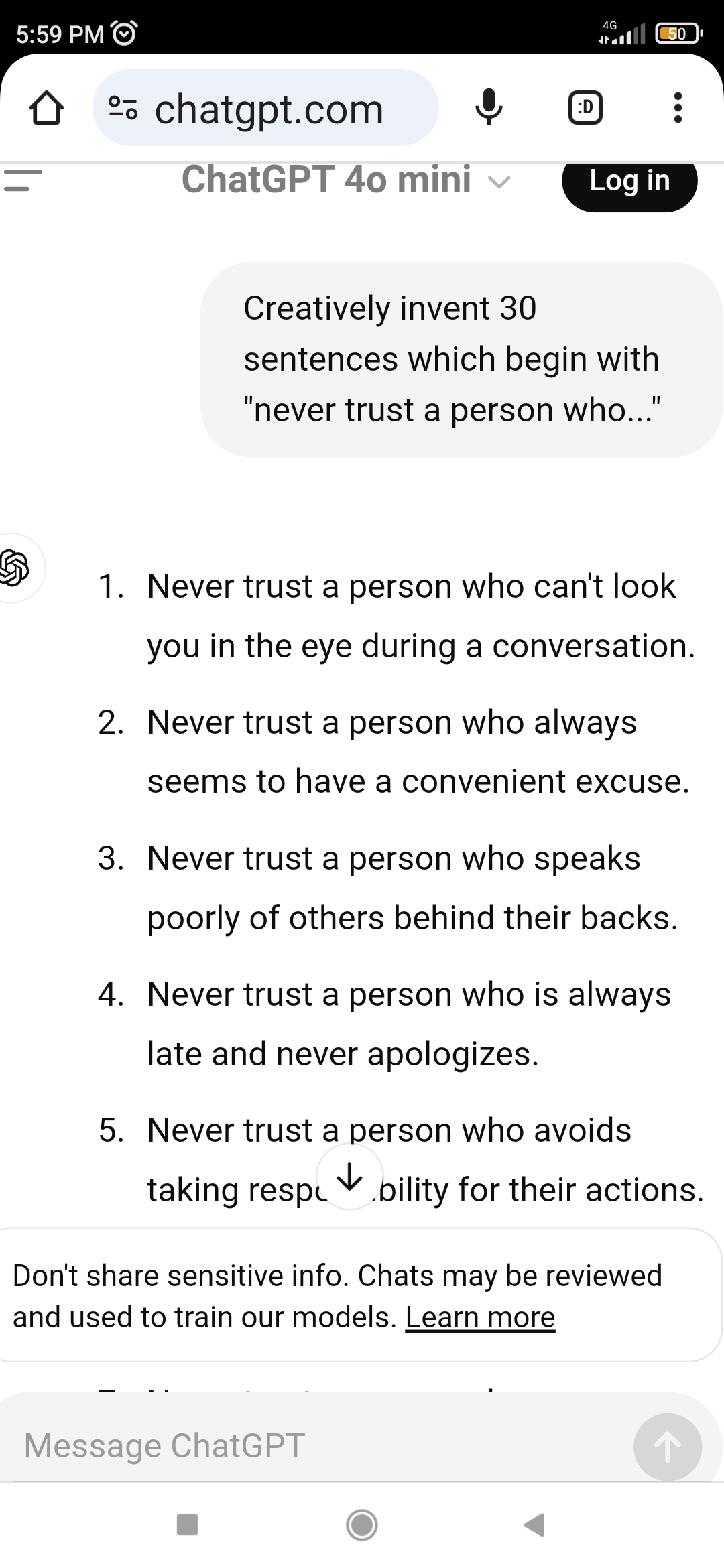
Note: Some Random Sentences From ChatGPT On Who We Must Not Trust And Who May Be Reliable

 بسم الله الرحمن الرحيم 

1. Never trust a person who can't look you in the eye during a conversation.

2. Never trust a person who always seems to have a convenient excuse.

3. Never trust a person who speaks poorly of others behind their backs.

4. Never trust a person who is always late and never apologizes.

5. Never trust a person who avoids taking responsibility for their actions.

6. Never trust a person who consistently dismisses your opinions.

7. Never trust a person who seems overly eager to win your approval.

8. Never trust a person who has a different story every time you ask them something.

9. Never trust a person who never admits to being wrong.

10. Never trust a person who constantly boasts about their achievements.

11. Never trust a person who says one thing but does another.

12. Never trust a person who uses flattery as their primary mode of communication.

13. Never trust a person who is always surrounded by drama and conflict.

14. Never trust a person who frequently changes their core values.

15. Never trust a person who can’t keep a secret, even when they promise they will.

16. Never trust a person who is always the center of attention and never lets others shine.

17. Never trust a person who seems to benefit from every situation at someone else’s expense.

18. Never trust a person who has a history of breaking promises.

19. Never trust a person who can’t handle constructive criticism gracefully.

20. Never trust a person who only reaches out to you when they need something.

21. Never trust a person who never expresses genuine emotions.

22. Never trust a person who seems to have a new best friend every week.

23. Never trust a person who manipulates others to get what they want.

24. Never trust a person who always knows a little too much about your private life.

25. Never trust a person who is always quick to judge others harshly.

26. Never trust a person who has a habit of exaggerating stories.

27. Never trust a person who always seems to have a hidden agenda.

28. Never trust a person who avoids discussing their own life or past.

29. Never trust a person who is overly critical of others yet never self-reflective.

30. Never trust a person who claims to be perfect and never makes mistakes.

⤴️ ChatGPT

1. A person could be trustworthy and genuinely care about you if they consistently support your goals and dreams.

2. A person could be trustworthy and genuinely care about you if they listen to your concerns without judgment.

3. A person could be trustworthy and genuinely care about you if they keep their promises and follow through on commitments.

4. A person could be trustworthy and genuinely care about you if they respect your boundaries and personal space.

5. A person could be trustworthy and genuinely care about you if they admit their mistakes and apologize sincerely.

6. A person could be trustworthy and genuinely care about you if they make an effort to understand your perspective.

7. A person could be trustworthy and genuinely care about you if they celebrate your successes and stand by you during failures.

8. A person could be trustworthy and genuinely care about you if they offer constructive feedback and encouragement.

9. A person could be trustworthy and genuinely care about you if they prioritize your well-being and happiness.

10. A person could be trustworthy and genuinely care about you if they are consistent in their actions and words.

11. A person could be trustworthy and genuinely care about you if they show empathy and compassion during difficult times.

12. A person could be trustworthy and genuinely care about you if they share their own thoughts and feelings openly.

13. A person could be trustworthy and genuinely care about you if they respect your choices and decisions.

14. A person could be trustworthy and genuinely care about you if they are reliable in both big and small matters.

15. A person could be trustworthy and genuinely care about you if they protect your confidences and keep your secrets.

16. A person could be trustworthy and genuinely care about you if they demonstrate patience and understanding.

17. A person could be trustworthy and genuinely care about you if they make an effort to be present and engaged in your life.

18. A person could be trustworthy and genuinely care about you if they treat you with kindness and respect at all times.

19. A person could be trustworthy and genuinely care about you if they are honest with you, even when it's difficult.

20. A person could be trustworthy and genuinely care about you if they seek to resolve conflicts with you in a fair and respectful manner.

21. A person could be trustworthy and genuinely care about you if they take your feelings and opinions into account.

22. A person could be trustworthy and genuinely care about you if they are dependable in both emotional and practical support.

23. A person could be trustworthy and genuinely care about you if they show appreciation and gratitude for your presence in their life.

24. A person could be trustworthy and genuinely care about you if they help you grow and improve without criticism or judgment.

25. A person could be trustworthy and genuinely care about you if they respect your need for privacy and independence.

26. A person could be trustworthy and genuinely care about you if they are willing to make sacrifices for your well-being.

27. A person could be trustworthy and genuinely care about you if they express their care through both actions and words.

28. A person could be trustworthy and genuinely care about you if they are genuinely interested in your happiness and success.

29. A person could be trustworthy and genuinely care about you if they make an effort to understand your life and experiences.

30. A person could be trustworthy and genuinely care about you if they support you through both the good times and the bad.


⤴️ ChatGPT


1. Move on, don't give second chances to people who constantly let you down.

2. Move on, don't give second chances to people who disrespect your boundaries.

3. Move on, don't give second chances to people who consistently lie to you.

4. Move on, don't give second chances to people who undermine your self-worth.

5. Move on, don't give second chances to people who repeatedly break your trust.

6. Move on, don't give second chances to people who refuse to apologize sincerely.

7. Move on, don't give second chances to people who treat you as an option rather than a priority.

8. Move on, don't give second chances to people who make you feel unimportant.

9. Move on, don't give second chances to people who only reach out when they need something.

10. Move on, don't give second chances to people who constantly criticize you unfairly.

11. Move on, don't give second chances to people who disregard your feelings.

12. Move on, don't give second chances to people who never make an effort to change.

13. Move on, don't give second chances to people who manipulate or control you.

14. Move on, don't give second chances to people who blame you for their mistakes.

15. Move on, don't give second chances to people who make excuses instead of taking responsibility.

16. Move on, don't give second chances to people who prioritize their needs over yours.

17. Move on, don't give second chances to people who drain your energy and enthusiasm.

18. Move on, don't give second chances to people who act only in their own self-interest.

19. Move on, don't give second chances to people who ignore your contributions and efforts.

20. Move on, don't give second chances to people who habitually take you for granted.

21. Move on, don't give second chances to people who betray your confidence.

22. Move on, don't give second chances to people who constantly bring negativity into your life.

23. Move on, don't give second chances to people who refuse to make amends for their actions.

24. Move on, don't give second chances to people who make you feel like you’re not enough.

25. Move on, don't give second chances to people who repeatedly disappoint you.

26. Move on, don't give second chances to people who show no respect for your time.

27. Move on, don't give second chances to people who have proven to be unreliable.

28. Move on, don't give second chances to people who don’t appreciate your presence in their life.

29. Move on, don't give second chances to people who make you question your self-worth.

30. Move on, don't give second chances to people who lack genuine empathy for your struggles.

⤴️ ChatGPT