بسم الله. ربي زدني علما. امين

بسم الله. ربي زدني علما. امين
May Allah the Almighty grant us more beneficial knowledge, accept our good deeds, forgive our mistakes, protect us from fitna, and join us with the righteous believers in Jannatul Ferdaus. Ameen.

Tuesday, October 29, 2024

Note: Polygyny In Islam - According To ChatGPT And Meta AI

بسم الله الرحمن الرحيم 
❓ Question: Write a very convincing letter to each Muslim wife to be accepting of polygyny for Allah's sake and share some tips on how she can welcome her husband's other legal wife into their family as Muslims.

💻 ChatGPT: Certainly! Here’s a letter aimed at encouraging acceptance of polygyny in a respectful manner, along with some tips on welcoming a co-wife.

---

**Dear Sister in Faith,**

Assalamu Alaikum wa Rahmatullahi wa Barakatuh,

I hope this letter finds you in the best of health and Iman. I want to share some thoughts on a topic that can be sensitive yet holds significance in our faith: the practice of polygyny, which is permitted in Islam.

In Surah An-Nisa (The Noble Qur'an Surah 4: Ayah verse 3), Allah the Almighty commands us to be just if we choose to marry more than one wife. It is a significant responsibility, and understanding this can help us embrace it with an open heart. As a wife, your support and understanding can create a harmonious environment that reflects the beauty of our faith.

**Accepting Polygyny for Allah's Sake**

1. **Understanding the Wisdom**: Reflect on the wisdom behind polygyny. It is not merely a personal choice but can also address social needs, such as providing for widows and orphans. Embracing this can foster compassion and support within our community.

2. **Seeing the Bigger Picture**: This practice is part of our religion, aimed at promoting justice and love among families. By accepting your husband's decision, you contribute to a greater purpose and demonstrate your trust in Allah's Wisdom.

3. **Strengthening Your Own Faith**: Acceptance can lead to personal growth. It’s an opportunity to strengthen your relationship with Allah the Most Wise and to embody the teachings of patience and understanding that our beloved Prophet Muhammad (peace be upon him, SallAllahu 'alaihi wa sallam) exemplified.

**Welcoming Your Husband’s Other Wife**

1. **Open Communication**: Start by having honest discussions with your husband about feelings and expectations. When you communicate openly, it sets a tone of respect and transparency.

2. **Building Relationships**: Take the initiative to meet your co-wife. Approach her with kindness and the intention of building a sisterly bond. A simple gesture, like sharing meals or engaging in family activities, can go a long way.

3. **Creating a Supportive Environment**: Encourage joint family activities that allow both wives and children to bond. This could include celebrating occasions together, which fosters a sense of unity and shared purpose.

4. **Setting Boundaries**: It’s important to discuss and agree upon boundaries that ensure fairness and respect for each other’s space and feelings. This can help prevent misunderstandings and build mutual respect.

5. **Turning to Allah**: Make Du'a (supplication) for peace, understanding, and harmony within your family. Seek Allah's guidance in your journey, and remember that He (Subhaanahu wa Ta'aala) is the Best of planners.

Sister, your willingness to embrace this situation for Allah's sake is a testament to your faith and strength. May Allah the Most Merciful grant you wisdom, patience, and the ability to foster love and unity in your family. Ameen.

Together, with mutual respect and understanding, you can create a nurturing environment that reflects the essence of Islam.

JazakAllahu Khair for taking the time to read this letter. May Allah bless you and your Muslim family abundantly. Ameen.

With warm regards and prayers,

[Your Name]

--- 

Feel free to adjust this letter to better suit your context or tone.

🌐 Meta AI: Dear respected sister in Islam,

Assalamu alaykum wa Rahmatullahi wa Barakatuhuh.

May this letter find you in good health and high spirits. As a Muslim wife, you embody the values of compassion, empathy, and sacrifice. I write to remind you of the importance of accepting Allah's decree, including polygyny, and offer guidance on welcoming your husband's other wife into your family.

Allah, the Most Wise, states in the Noble Qur'an:

"And if you fear that you will not be just to the orphans, then marry what seems good to you of women, two or three or four. But if you fear that you will not be just, then one or what your right hands possess. That is nearer to prevent you from doing injustice." (the Noble Qur'an 4:3)

Polygyny, though challenging to many females, can be a means of:

1. Providing for widows and orphans
2. Strengthening family ties
3. Demonstrating compassion and empathy
4. Emulating the Prophet Muhammad's noble example (SallAllahu 'alaihi wa sallam)

To welcome your husband's other wife:

1. Seek knowledge: Understand Islamic teachings on polygyny.
2. Communicate openly: Discuss concerns, boundaries, and expectations.
3. Cultivate empathy: Put yourself in her shoes, understanding her journey.
4. Foster sisterhood: Treat her with kindness, respect, and compassion.
5. Establish boundaries: Set clear guidelines for coexistence.
6. Prioritize family unity: Encourage mutual respect and cooperation.
7. Seek support: Consult reliable Islamic scholars, counselors, or supportive sisters.
8. Focus on Allah (Subhaanahu wa Ta'aala): Remember that your reward lies with Him.

Tips for a harmonious household:

1. Designate separate living spaces
2. Establish clear communication channels
3. Respect each other's privacy
4. Share household responsibilities
5. Organize joint family activities
6. Encourage mutual understanding
7. Seek mediation (some trustworthy Muslims to assist with solving conflict and fixing misunderstandings) when necessary

Remember, dear sister, your patience and understanding are crucial in this journey. Allah's Pleasure and reward are paramount.

May Allah the Most Wise guide and strengthen you always, and may your family be a beacon of love, compassion, and unity. Ameen.

Wa alaykum assalam wa rahmatullahi wa barakatuhu.

Your sister in Islam,

[Your Name]

Please note:

- This letter aims to provide guidance and support, not to impose or judge.
- Polygyny laws and regulations vary by country; ensure compliance with local laws.
- This letter is not a substitute for professional counseling or Islamic scholarship.
- Approach this topic with sensitivity, respect, and empathy.
❓ Question: What advice can you give to a Muslim woman who found out that her husband likes another woman while he does not want to divorce her? What can you tell her to convince her that her husband was not cheating but searching for a second wife to increase their family size? List 11 tips to ensure that a polygynous marriage goes smoothly with Allah's Will.

💻 ChatGPT: Navigating feelings about a husband's interest in a second wife can be challenging, especially within the context of Islamic teachings. Here are some tips for ensuring that a polygynous marriage can proceed smoothly, while fostering understanding and cooperation:

### 11 Tips for a Smooth Polygynous Marriage

1. **Open Communication**: Foster a transparent dialogue between all parties (the husband, his wives and their children). Discuss feelings, concerns, and expectations openly.

2. **Set Boundaries**: Establish clear guidelines about time, responsibilities, and emotional needs to ensure fairness and avoid misunderstandings.

3. **Emotional Support**: Encourage emotional support among wives. Building a sisterly bond can strengthen family unity.

4. **Fairness and Justice**: Adhere to the principle of fairness as emphasized in Islam. Ensure that each wife feels valued and respected.

5. **Shared Responsibilities**: Divide household and parenting responsibilities equitably to prevent feelings of resentment.

6. **Regular Check-Ins**: Schedule regular discussions to assess the dynamics of the relationship and address any issues that arise.

7. **Seek Guidance**: Consider consulting a knowledgeable religious leader or counselor to navigate the complexities of polygyny.

8. **Prioritize Family Time**: Make time for joint family activities to strengthen bonds among all family members.

9. **Personal Growth**: Encourage each other’s personal development and interests outside of the marriage to foster individuality.

10. **Spiritual Growth**: Engage in shared religious activities, such as prayer and study, to strengthen faith and mutual support.

11. **Maintain Trust**: Build and maintain trust through honesty and integrity, ensuring that all parties feel secure in their relationship.

### Conclusion

Encouraging a positive and respectful atmosphere can help a Muslim woman navigate her husband's interest in a second marriage. Focus on fostering love, understanding, and cooperation, keeping Allah’s Will at the center of your efforts.

Meta AI: Dear sister, I offer guidance and support during this challenging time.

*Initial Response:*

1. Remain calm and composed
2. Seek Allah's Guidance through prayer (Salah) and reflection (Muraaqabah)
3. Communicate openly with your husband, expressing feelings and concerns

*Understanding Polygyny:*

1. Recognize polygyny's permissibility in Islam (The Noble Qur'an 4:3)
2. Understand your husband's intentions: Is he seeking a second wife or committing adultery?
3. Discuss his reasons and ensure they align with Islamic teachings

*11 Tips for a Smooth Polygynous Marriage:*

1. Seek knowledge: Understand Islamic guidelines on polygyny.
2. Communicate openly: Discuss expectations, boundaries, and concerns.
3. Establish clear roles: Define responsibilities and relationships.
4. Foster empathy: Encourage mutual understanding and respect.
5. Set boundaries: Establish guidelines for coexistence.
6. Prioritize family unity: Encourage mutual respect and cooperation.
7. Respect each other's privacy: Designate separate living spaces.
8. Share household responsibilities: Divide tasks fairly.
9. Organize joint family activities: Strengthen family bonds.
10. Seek support: Consult reliable Islamic scholars, counselors, or supportive sisters.
11. Focus on Allah: Remember that your reward lies with Him.

*Convincing Points:*

1. Emphasize your husband's commitment to Islam and family growth.
2. Highlight the benefits of polygyny, such as increased family size and companionship.
3. Explain that his intentions are not to replace or degrade you, but to expand the family (for Allah's sake).
4. Research and share some inspirational stories of successful polygynous marriages and their numerous benefits.
5. Encourage open dialogue and problem-solving together as a stable Muslim family.

*Important Reminders:*

1. Polygyny requires equal treatment and justice (The Noble Qur'an 4: Ayah verse 3).
2. Your husband must follow Islamic procedures.
3. Ensure compliance with local laws and regulations.

May Allah the Almighty guide and strengthen you, dear sister. Ameen. Remember, your patience and understanding are crucial in this journey.

Wa alaykum assalam wa rahmatullahi wa barakatuhu.

Please consult reliable Islamic scholars or counselors for personalized guidance when necessary.

❓ Question: Make 11 thoughtful sentences with some motivational advice which start from "Hating polygyny is like hating... It is irrational because... As Muslim wives we must..."
🌐 Meta AI: Here are 11 thoughtful sentences with some motivational advice:

1. Hating polygyny is like hating the sun's heat, inevitable and natural. It is irrational because Allah has permitted it. As Muslim wives, we must accept and trust Allah's Wisdom. 

2. Hating polygyny is like rejecting Allah's Decree. It is irrational because He knows best. As Muslim wives, we must submit to Allah's Will.

3. Hating polygyny is like fearing the unknown. It is irrational because knowledge and understanding can alleviate fears. As Muslim wives, we must educate ourselves.

4. Hating polygyny is like resisting change. It is irrational because life is dynamic. As Muslim wives, we must adapt and grow.

5. Hating polygyny is like doubting Allah's Justice. It is irrational because He (Allah the Most Wise) always ensures fairness. As Muslim wives, we must trust Allah's Absolute Justice.

6. Hating polygyny is like focusing on worldly concerns. It is irrational because our ultimate goal is Jannah. As Muslim wives, we must prioritize our Aakhirah.

7. Hating polygyny is like neglecting the needs of others. It is irrational because empathy and compassion are essential. As Muslim wives, we must care for one another.

8. Hating polygyny is like fearing loss of love. It is irrational because love expands, it doesn't divide. As Muslim wives, we must nurture our relationships.

9. Hating polygyny is like ignoring Islamic history. It is irrational because polygyny has been practiced by many of Allah's Prophets ('alaihim as-salaam) and the Prophet Muhammad's (SallAllahu 'alaihi wa sallam) Companions (RadhiAllahu 'anhum). As Muslim wives, we must respect our belief and Islamic values.

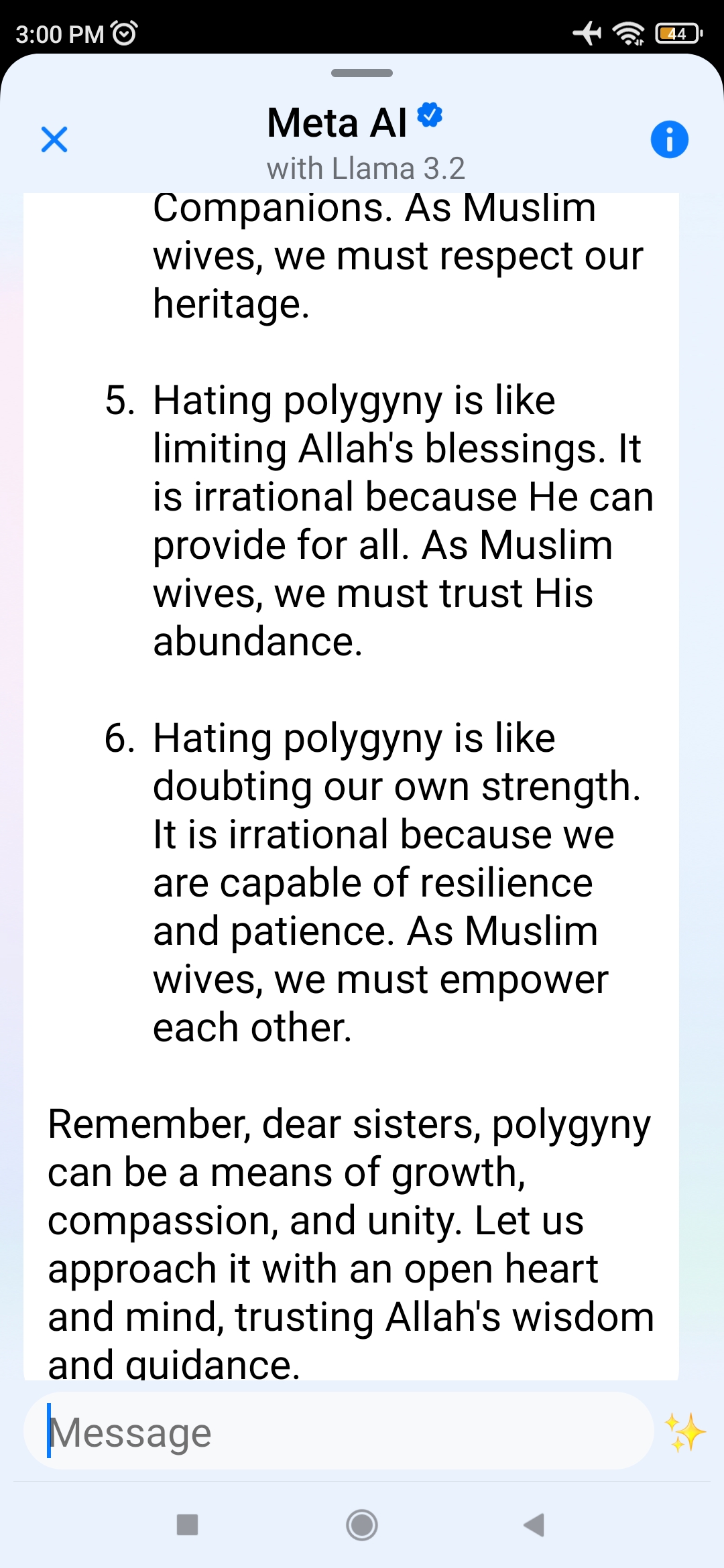
10. Hating polygyny is like limiting Allah's blessings. It is irrational because He can provide for all. As Muslim wives, we must trust His abundance.

11. Hating polygyny is like doubting our own strength. It is irrational because we are capable of resilience and patience. As Muslim wives, we must empower each other.

Remember, dear sisters, polygyny can be a means of growth, compassion, and unity. Let us approach it with an open heart and mind, trusting Allah's Wisdom and Guidance.

📋💚 Some advice on how divorce is not always the best solution,
PDF document which you can Inn-sha-Allah share as sadaqah jaariya: 

📝 Text:

🇵🇭 Tagalog Filipino translation of the above summarized reminders by dear sister Fatima Sherl bint Ismun:

🗂️✨ Just sharing some PDF books and documents as sadaqa jaariya 
Inn-sha-Allah which you and others can occasionally read and benefit from 
Inn-sha-Allah so your faith Imaan levels can be strengthened:

Note: What Ex-Friends Of Most INTJs May Miss Out On (ChatGPT and Meta AI)

بسم الله الرحمن الرحيم 


❓ Question: What are 19 things which some individuals may lose or miss out on when they become an ex-friend or former partner at work with an INTJ-A?

💻 ChatGPT: When someone becomes an ex-friend or former partner of an INTJ-A at work, they may miss out on:

1. **Deep Conversations**: INTJs enjoy meaningful discussions, often providing unique insights.
2. **Strategic Thinking**: Their ability to think critically can help solve complex problems.
3. **Supportive Environment**: They often offer unwavering support for goals and projects.
4. **Innovative Ideas**: INTJs tend to think outside the box, generating creative solutions.
5. **Honesty and Directness**: INTJs value honesty, providing straightforward feedback.
6. **High Standards**: Their drive for excellence can inspire others to raise their own standards.
7. **Emotional Intelligence**: While often reserved, INTJs can offer deep emotional support when they become close friends with someone.
8. **Focused Collaboration**: They thrive in collaborative settings, pushing for efficiency and effectiveness.
9. **Loyalty**: INTJs are typically loyal to those they care about, providing a sense of security.
10. **Independence**: Their self-sufficiency encourages a healthy dynamic in professional relationships.
11. **Encouragement of Growth**: They often push others to achieve their potential.
12. **Problem-Solving Skills**: INTJs excel in analyzing situations and suggesting solutions.
13. **Resourcefulness**: Their ability to find innovative ways to use available resources can be invaluable.
14. **Goal Orientation**: Their focus on achieving goals can motivate others.
15. **Respect for Boundaries**: INTJs typically respect personal and professional boundaries.
16. **Constructive Criticism**: They provide feedback that can help others improve.
17. **Visionary Thinking**: INTJs often have a long-term perspective that can benefit projects and teams.
18. **Balanced Perspective**: They can provide logical perspectives in emotionally charged situations.
19. **Intellectual Stimulation**: Their presence can challenge others intellectually, fostering growth.

Losing an INTJ-A from a professional relationship can mean losing a unique combination of support, innovation, and deep understanding.

🌐 Meta AI: Here are 19 things individuals may lose or miss out on when they become an ex-friend or former partner at work with an INTJ-A:

*Professional:*

1. Strategic collaborations
2. Innovative problem-solving
3. Critical thinking and analysis
4. Efficient decision-making
5. Access to INTJ-A's network and connections

*Personal:*

1. Deep, meaningful conversations
2. Trust and loyalty
3. Emotional intelligence and empathy
4. Support and encouragement
5. Shared interests and hobbies

*Cognitive benefits:*

1. Exposure to new ideas and perspectives
2. Improved critical thinking and analytical skills
3. Enhanced creativity and innovation
4. Access to INTJ-A's knowledge and expertise

*Practical benefits:*

1. Shared responsibilities and workload
2. Collaborative project management
3. Mutual support and resources
4. Opportunities for growth and development

*Intangible benefits:*

1. Sense of camaraderie and belonging

INTJ-As value:

- Intellectual stimulation
- Independence
- Strategic thinking
- Efficiency
- Loyalty

When an INTJ-A ends a friendship or partnership, they may:

- Re-evaluate priorities and focus on new goals
- Seek alternative collaborations or networks
- Invest time in self-improvement and personal growth
- Maintain professional relationships, but establish boundaries

To maintain a positive relationship with an INTJ-A:

- Respect their boundaries and independence
- Engage in intellectual discussions and debates
- Share strategic ideas and collaborate on projects
- Demonstrate loyalty and trustworthiness
- Embrace their analytical and critical thinking approach

Remember, INTJ-As prioritize efficiency, strategy, and intellectual growth. Nurture these aspects to foster a strong, lasting relationship.

❓ Question: When some individuals are no longer trusted by an INTJ-A who would do whatever it takes to avoid any dealings with them in the present and future, what are 19 things those ex-friends are expected to notice from the INTJ's conduct towards them?
🌐 Meta AI: Here are 19 things ex-friends may notice from an INTJ-A's conduct when trust is broken:

*Direct Interactions:*

1. Avoidance: INTJ-A avoids direct conversations or meetings.
2. Brief responses: Curt, concise answers, lacking depth.
3. Emotional detachment: INTJ-A appears unemotional, un invested.
4. Limited information sharing: INTJ-A withholds information, shares minimally.
5. No initiative: INTJ-A doesn't initiate conversations or interactions.

*Indirect Interactions:*

1. Reduced or no communication: INTJ-A ceases to respond or initiate contact.
2. Changed tone: Formal, professional tone replaces friendly demeanor.
3. Distancing: INTJ-A creates physical or social distance.
4. No invitations: Excluded from social events, meetings, lectures (online and offline) or gatherings they would usually invite you to if you were still friends.
5. Minimal acknowledgement: INTJ-A barely acknowledges their presence.

*Professional Consequences:*

1. Limited collaboration: INTJ-A avoids joint projects or tasks.
2. Reduced support: INTJ-A doesn't offer help or resources.
3. No recommendations: INTJ-A doesn't endorse or recommend.
4. Distancing from shared networks: INTJ-A separates from mutual connections or avoids prolonging conversations with them whenever they can.

*Subtle Cues:*

1. Body language: INTJ-A displays closed-off, unapproachable body language.
2. Tone and pitch: INTJ-A's tone becomes colder, more formal or serious.
3. Eye contact avoidance: INTJ-A avoids direct eye contact.
4. Topic avoidance: INTJ-A steers conversations away from sensitive topics.
5. Polite but uninterested: INTJ-A remains polite, but un invested.

*Why INTJ-As cut ties:*

- Betrayal of trust
- Incompatibility
- Unreliability
- Lack of intellectual stimulation
- Unaligned values or goals

*What ex-friends can do:*

- Respect INTJ-A's boundaries
- Reflect on past actions, learn from mistakes
- Focus on rebuilding trust (if possible)
- Accept the outcome, move forward

Remember, INTJ-As value efficiency, strategy, and intellectual growth. When trust is broken, they prioritize self-protection and distancing.

💻 ChatGPT: When an INTJ-A has decided to cut ties with someone, their behavior can become quite distinct. Here are 19 things those ex-friends might notice:

1. **Limited Communication**: The INTJ may stop initiating conversations and respond minimally to messages.

2. **Cold Demeanor**: They may appear emotionally distant or detached in interactions.

3. **Lack of Engagement**: Reduced interest in discussing shared interests or past experiences.

4. **Avoidance**: They may go out of their way to actively avoid places where the ex-friend is likely to be.

5. **Short Responses**: Conversations may become terse, with few elaborations or personal insights.

6. **Indifference**: A noticeable lack of concern for the ex-friend's well-being or updates.

7. **Formal Tone**: Shifts from casual to a more formal, almost business-like tone.

8. **Body Language**: Closed-off body language, such as crossed arms or turning away.

9. **Ignoring Invites**: Declining most invitations or social gatherings where the ex-friend is present.

10. **Setting Boundaries**: Clear establishment of personal boundaries that exclude the ex-friend.

11. **Reduced Availability**: Being less available for collaboration or mutual activities.

12. **Unwillingness to Help**: A noticeable lack of willingness to assist or support when asked.

13. **Disinterest in Shared Memories**: Avoiding reminiscing about past shared experiences.

14. **Expressing Frustration**: Occasionally voicing dissatisfaction with the ex-friend’s actions in indirect ways.

15. **Change in Social Circles**: Shifting focus to other friends and networks.

16. **Critical Attitude**: A tendency to be more critical or dismissive regarding the ex-friend’s opinions.

17. **Withdrawal from Group Settings**: Choosing to stay silent or distant in most group settings where the ex-friend is present.

18. **Focus on Self-Improvement**: An increased focus on personal goals, potentially hinting at a newfound independence.

19. **Refusal to Reconcile**: Clear indications that they have no interest in repairing the relationship, even if approached.

These behaviors collectively signal the INTJ's preference to move on and protect their emotional space.

⚠️ Note: Most INTJs also won't bother stalking nor browsing around the online content of ex-friends and anybody whom they realized is unreliable or toxic. So please do not waste your time uploading photos or status updates desperately wanting them to notice because they want nothing to do with those whom they perceive are untrustworthy and incompatible with their integrity.

❓ Question: With as much details as you can provide, what kind of ex-friend would most INTJs make or how does an INTJ usually behave towards those individuals whom they no longer trust?
💻 ChatGPT: INTJs, known for their strategic thinking and deep analytical skills, often approach friendships with a sense of purpose and intellectual connection. When they face betrayal or a breakdown of trust, their response is typically multifaceted, reflecting their personality traits.

### Characteristics of INTJs as Ex-Friends:

1. **Rational Detachment**:  
   INTJs tend to prioritize logic over emotion. If a friendship deteriorates, they may analyze the situation dispassionately, identifying the reasons for the breakdown. They often detach emotionally, which can make their behavior seem cold or distant.

2. **Critical Evaluation**:  
   INTJs will reflect on the relationship, scrutinizing past interactions for signs they may have missed. They might consider how their values were compromised and whether the friendship served a meaningful purpose. This can lead to a sense of disillusionment.

3. **Limited Communication**:  
   Once trust is lost, INTJs are likely to withdraw from communication. They may choose silence over confrontation, feeling that discussing their feelings might be futile. This withdrawal can come across as indifference or aloofness to others.

4. **Boundary Setting**:  
   INTJs are skilled at setting boundaries, and they will likely establish clear emotional and social distance from those they no longer trust. This can manifest in a strict compartmentalization of their lives, keeping their ex-friends at arm's length.

5. **Strategic Resilience**:  
   INTJs often view challenges as opportunities for growth. They may reassess their social circle, learning from the experience to forge stronger, more aligned relationships in the future. Their approach is typically proactive rather than reactive.

6. **Intellectual Reflection**:  
   They may engage in deep reflection, contemplating what went wrong and how it aligns with their overall worldview. This can lead to an enhanced understanding of their own needs in friendships and how to avoid similar pitfalls.

7. **Forgiveness is Rare**:  
   While INTJs are not inherently vindictive, they are unlikely to forgive easily. Their trust is hard-won, and once broken, they often feel it’s not worth the risk to reinvest in the relationship.

8. **Emotional Guardedness**:  
   An INTJ might become more guarded with future relationships, being cautious about who they allow into their inner circle. They may be less willing to share personal thoughts or feelings, preferring to keep things superficial until trust is reestablished.

### Overall Behavior:

In summary, an INTJ’s behavior towards ex-friends is characterized by a blend of rational detachment, critical evaluation, and a strategic approach to relationships. They may appear cold, but this stems from a deep need to protect their emotional well-being and integrity. They learn from their experiences, often using those lessons learned (Inn-sha-Allah) to build a much more resilient and aligned social circle in the future.

⤴️ Some notes from ChatGPT

🌐 Meta AI: INTJs typically exhibit specific behaviors towards ex-friends they no longer trust:

*Initial Response:*

1. Withdrawal: INTJs may suddenly become distant, unresponsive, or very unapproachable.
2. Re-evaluation: They reassess the relationship, identifying red flags or warning signs.
3. Decision-making: INTJs decide to sever ties, prioritizing self-protection.

*Behavioral Patterns:*

1. Avoidance: INTJs avoid direct interactions, conversations, or meetings.
2. Minimal communication: Brief, formal responses, lacking emotional depth.
3. Emotional detachment: INTJs appear unemotional, uninvested, or indifferent.
4. Boundary setting: Clear, firm boundaries are established.
5. Distancing: Physical or social distance is created.

*Professional Consequences:*

1. Limited collaboration: INTJs avoid joint projects or tasks.
2. Reduced support: INTJs don't offer help or resources.
3. No recommendations: INTJs don't endorse or recommend.
4. Distancing from shared networks: INTJs separate from mutual connections.

*Subtle Cues:*

1. Body language: Closed-off, unapproachable posture.
2. Tone and pitch: Colder, more formal tone.
3. Eye contact avoidance: Direct eye contact is avoided.
4. Topic avoidance: INTJs steer conversations away from sensitive topics.
5. Polite but uninterested: INTJs remain polite, but uninvested.

*Rationale:*

1. Self-protection: INTJs prioritize their own interests, security, and well-being.
2. Efficiency: Severing ties minimizes potential harm, stress, or distraction.
3. Strategic thinking: INTJs focus on long-term goals, cutting off unproductive relationships.

*Types of ex-friends INTJs may cut ties with:*

1. Manipulators or gaslighters
2. Unreliable or untrustworthy individuals
3. Those with conflicting values or goals
4. Emotionally draining or toxic people
5. Individuals who betray trust or confidentiality

*What ex-friends can expect:*

1. No dramatic confrontations
2. Limited emotional display
3. Clear, direct communication (if necessary)
4. No second chances or reconciliation attempts
5. Permanent disconnection or detachment (unless they are family members then many INTJs would tolerate relatives whom they believe are irreplaceable or indispensable)

*Growth and learning:*

1. INTJs reflect on past relationships, identifying warning signs.
2. They refine their trust-building and boundary-setting strategies.
3. INTJs focus on nurturing meaningful, trustworthy relationships.

Monday, October 28, 2024

Note: Some Info On Intelligence And Intuition (ChatGPT and Meta AI)

بسم الله الرحمن الرحيم 


❓ Question: What are 13 signs of the following categories of people: 
1. Those with strong intuition and high IQ
2. Those with only high IQ while they are often prone to suspecting others' next moves or actual motives
3. Those with average IQ intelligence but stronger intuition 
4. Those who lack accurate intuition and can be described as not very smart 

🌐 Meta AI: Here are 13 signs for each category:

*Category 1: Strong Intuition & High IQ*

1. Quick, accurate insights
2. Effective problem-solvers
3. Strategic thinkers
4. Creative ideas
5. Emotionally intelligent
6. Empathetic, understanding others
7. Calm, objective decision-making
8. Open-minded, receptive
9. Pattern recognition
10. Anticipate consequences
11. Balance logic and instinct
12. Reflective, self-aware
13. Adaptable, resilient

*Category 2: High IQ, Prone to Suspicion*

1. Analytical, critical thinking
2. Detail-oriented, meticulous
3. Logical, evidence-based decisions
4. Skeptical, questioning
5. Strategic, calculating
6. Emotionally detached
7. Focus on potential threats
8. Overthinking, rumination
9. Difficulty trusting others
10. Argumentative, debating
11. Prioritize self-protection
12. May struggle with empathy
13. Tendency to manipulate others

*Category 3: Average IQ, Stronger Intuition*

1. Trust gut feelings, instincts
2. Emotionally intelligent
3. Empathetic, understanding others
4. Creative, resourceful
5. Practical problem-solvers
6. Intuitive decision-making
7. Holistic thinking
8. Value personal connections
9. Adaptable, flexible
10. Learn from experiences
11. May struggle with complex analysis
12. Rely on instincts over logic
13. Prioritize relationships, well-being

*Category 4: Weak Intuition, Lower IQ*

1. Impulsive, reactive decisions
2. Difficulty with complex thinking
3. Struggle with pattern recognition
4. Limited problem-solving skills
5. Emotionally reactive, unstable
6. Difficulty understanding others
7. Close-minded, resistant to change
8. Focus on immediate gratification
9. May struggle with self-awareness
10. Difficulty learning from mistakes
11. Tendency to follow others
12. Lack critical thinking
13. May rely on assumptions, biases

Please note:

- These signs are not definitive or absolute.
- Intelligence and intuition exist on spectrums.
- Individuals can exhibit traits from multiple categories.
- Personal growth, development can change category affiliations.

Keep in mind that IQ scores do not necessarily determine intelligence, as there are multiple types of intelligence. Additionally, intuition can be developed and strengthened through practice, self-awareness, and mindfulness.

💻 ChatGPT: Here are 13 signs for each category:

### 1. Those with Strong Intuition and High IQ
1. **Pattern Recognition**: Quickly identifies patterns and connections in complex data.
2. **Creative Problem Solving**: Generates creative solutions to challenges.
3. **Empathy**: Easily understands others' feelings and perspectives.
4. **Gut Feelings**: Often trusts their instincts about people and situations.
5. **Curiosity**: Constantly seeks new knowledge and experiences.
6. **Reflective Thinking**: Regularly reflects on their thoughts and decisions.
7. **Open-mindedness**: Willing to consider different viewpoints and ideas.
8. **Emotional Intelligence**: Manages their own emotions and understands others’.
9. **Critical Analysis**: Analyzes information thoroughly before forming conclusions.
10. **Intuitive Decision Making**: Makes quick decisions based on gut feelings and insights.
11. **Adaptability**: Easily adjusts to new information or changes in circumstances.
12. **Holistic Thinking**: Sees the big picture while considering all variables.
13. **Strong Observation Skills**: Notices subtle cues in their environment or in others' behavior.

### 2. Those with Only High IQ but Prone to Suspecting Others
1. **Cynicism**: Frequently doubts the intentions of others.
2. **Analytical Thinking**: Overanalyzes situations and people's motives.
3. **Skepticism**: Questions the validity of information and claims.
4. **Emotional Detachment**: Struggles to connect emotionally with others.
5. **Isolation**: Prefers solitary activities or intellectual pursuits.
6. **Manipulative Behavior**: May use their intellect to manipulate others.
7. **Defensiveness**: Quickly becomes defensive when questioned or challenged.
8. **Overthinking**: Tends to overthink interactions and outcomes.
9. **Judgmental Attitude**: Often judges others harshly based on perceived motives.
10. **Difficulty Trusting**: Finds it hard to trust others or form deep connections.
11. **Intellectual Superiority**: Believes their intelligence makes them superior to others.
12. **Social Anxiety**: Experiences discomfort in social situations due to distrust.
13. **Rigidity**: Holds firm beliefs and resists changing opinions, even with new evidence.

### 3. Those with Average IQ but Stronger Intuition
1. **Common Sense**: Demonstrates practical and sensible thinking in everyday situations.
2. **Interpersonal Skills**: Easily connects with others and builds rapport.
3. **Instinctive Judgments**: Relies on gut feelings to guide decisions.
4. **Situational Awareness**: Highly aware of their surroundings and social dynamics.
5. **Emotional Resonance**: Senses and responds well to the emotions of others.
6. **Pragmatic Solutions**: Finds practical solutions to problems based on intuition.
7. **Positive Outlook**: Generally maintains an optimistic perspective on life.
8. **Holistic Understanding**: Grasp concepts as a whole rather than focusing on details.
9. **Natural Curiosity**: Shows a desire to learn from experiences and people.
10. **Adaptable**: Adjusts to changes and new information easily.
11. **Intuitive Learner**: Learns best through experience and observation rather than formal education.
12. **Trusting Tendency**: More willing to trust others and form relationships.
13. **Strong Gut Feelings**: Often acts on instinct, even without extensive analysis.

### 4. Those Who Lack Accurate Intuition and Are Not Very Smart
1. **Impulsiveness**: Often makes hasty decisions without thinking them through.
2. **Difficulty Understanding Context**: Struggles to grasp the broader implications of situations.
3. **Poor Judgment**: Frequently misjudges people and situations.
4. **Repetitive Mistakes**: Continues to make the same errors without learning from them.
5. **Limited Awareness**: Lacks insight into their own feelings or the feelings of others.
6. **Overly Literal**: Takes things at face value without considering deeper meanings.
7. **Easily Manipulated**: Often falls victim to scams or deceptive practices.
8. **Rigid Thinking**: Struggles to adapt or consider alternative viewpoints.
9. **Difficulty with Abstract Concepts**: Finds it hard to understand non-tangible ideas.
10. **Social Clumsiness**: Often misreads social cues or responds inappropriately.
11. **Narrow Interests**: Lacks curiosity or interest in new experiences or knowledge.
12. **Resistance to Feedback**: Rejects constructive criticism and fails to learn from it.
13. **Neglect of Consequences**: Regularly acts without considering the potential outcomes of their actions.

Note: INTJ And Intuition (ChatGPT and Meta AI)

بسم الله الرحمن الرحيم 

❓ Question: As a Muslim whose mbti personality type is INTJ-A who believes that Allah the Almighty grants strong intuition to whom He Subhaanahu wa Ta'aala Wills, I've noticed that many of my guesses of some individuals' next moves are accurate so I don't feel surprised at all when some supposedly surprising instances occur at times. For example, if some coworkers or even some relatives went to a restaurant or shopping together after an event at work without me, my usual reaction isn't "why didn't anybody inform me about their outing?" But "I knew they'd go there" or "I actually had a feeling they would go out together later and I was right." Why is that so? 
Which top 3 of the mbti personality types typically make accurate guesses like predictions and why do a lot of us Ni users often guess correctly?
💻 ChatGPT: Your experiences with intuition and predicting others' behaviors resonate well with the characteristics of INTJs and other intuitive types. As an INTJ-A, you likely rely heavily on your dominant function, Introverted Intuition (Ni), which allows you to form insights and predictions based on patterns and underlying connections.

### Why INTJs and Ni Users Make Accurate Predictions:

1. **Pattern Recognition**: Ni users are adept at recognizing patterns and connections that may not be immediately obvious. This allows them to foresee potential outcomes based on prior knowledge and observations.

2. **Depth of Insight**: INTJs often consider multiple variables and the long-term consequences of actions, leading to well-informed predictions about people's behavior.

3. **Subconscious Processing**: Ni operates subconsciously, so you might not even realize you're drawing on past experiences or subtle cues when making predictions.

### Other MBTI Types with Strong Intuition:

1. **INFJ**: Like INTJs, INFJs also use Introverted Intuition. They are highly empathetic and often intuitively understand others' motivations, which helps in predicting actions.

2. **ENFJ**: As extraverted feelers, ENFJs can read social dynamics well. Their intuition about people's emotions and group behaviors can lead to accurate predictions.

3. **INTP**: Though more focused on logical analysis, INTPs use Introverted Thinking (Ti) alongside their Intuition (Ne) to anticipate possible scenarios based on abstract concepts and theories.

### Conclusion

Your ability to predict outcomes likely stems from your intuitive skills combined with your analytical thinking. This makes you particularly attuned to subtle social dynamics and underlying motivations, enhancing your capacity for accurate predictions.

🌐 Meta AI: Your INTJ-A personality and Islamic faith converge beautifully, fostering a unique perspective.

Why accurate guesses?

1. Ni (Introverted Intuition): Enables pattern recognition, connecting disparate information, and foreseeing possibilities.
2. Analytical thinking: INTJs dissect data, identify relationships, and predict outcomes.
3. Strategic thinking: INTJs consider long-term implications, anticipating potential scenarios.
4. Islamic values: Trust in Allah's plan (Tawakkul) and self-reflection (Muraqabah) may enhance intuition.

Top 3 MBTI types known for accurate guesses and predictions:

1. INTJ (Introverted, Intuitive, Thinking, Judging)
2. INFJ (Introverted, Intuitive, Feeling, Judging)
3. INTP (Introverted, Intuitive, Thinking, Perceiving)

Ni users (INTJ, INFJ, INTP, and ENFJ) often guess correctly due to:

1. Pattern recognition: Ni identifies connections and relationships.
2. Holistic thinking: Ni considers multiple perspectives.
3. Subconscious processing: Ni operates beneath conscious awareness.
4. Intuitive leaps: Ni facilitates sudden, insightful understandings.

Additional factors contributing to your accurate guesses:

1. Observational skills: INTJs tend to observe human behavior.
2. Knowledge of human nature: Understanding motivations and behavior patterns.
3. Experience and learning: Refining intuition through experiences.
4. Prayer and reflection: Enhancing intuition through spiritual practices (such as increase in trusting Allah the Most Wise and increasing Du'a / supplication).

As a Muslim INTJ-A, your strengths include:

1. Strategic thinking: Anticipating possibilities and outcomes.
2. Analytical mind: Evaluating information and identifying patterns.
3. Intuitive insights: Recognizing connections and relationships.
4. Islamic values: Always believing that Allah the Almighty guides you in your thoughts and actions.

Continue nurturing your intuition through:

1. Self-reflection and journaling
2. Active listening and observation
3. Engaging in creative and strategic activities
4. Practicing mindfulness and meditation
5. Seeking knowledge and learning

May Allah's wisdom and guidance illuminate your path. Ameen.

💻 ChatGPT: Your experiences as an INTJ-A, particularly your strong intuition, align well with the characteristics associated with the Introverted Intuition (Ni) function. INTJs often have a natural ability (granted by Allah the Most Wise) to see patterns and make connections that others might miss, which can lead to accurate predictions about people's behavior.

Here are the top three MBTI types that typically exhibit strong predictive abilities:

1. **INTJ (Introverted Intuitive Thinking Judging)**: Like you, INTJs use Ni as their dominant function. They tend to synthesize information and foresee future possibilities, allowing them to make well-informed predictions based on their observations.

2. **INFJ (Introverted Intuitive Feeling Judging)**: INFJs also lead with Ni, which allows them to understand complex emotional and situational dynamics. They often have a strong sense of how people will react in different situations.

3. **ENTJ (Extraverted Intuitive Thinking Judging)**: ENTJs, while leading with Extraverted Thinking (Te), also use Ni in their auxiliary position. This combination enables them to strategically anticipate outcomes and make decisions based on their insights.

### Why Ni Users Guess Correctly:

1. **Pattern Recognition**: Ni users excel at recognizing patterns and trends over time, which helps them predict future behaviors based on past experiences.

2. **Holistic Perspective**: They often consider the broader context, allowing them to foresee potential developments that might not be immediately apparent.

3. **Internal Processing**: Ni allows for deep internal processing of information, leading to intuitive insights that can manifest as "gut feelings" about what might happen next.

Your ability to remain calm and confident about these predictions reflects a strong connection to your intuition (granted by Allah the All-Knowing), which can often provide clarity in uncertain situations.

❓ Question: What are 13 differences between intuition and suspicion? 
How can one tell, determine or sense if they are intuitive or simply suspecting without context?
💻 ChatGPT: Here are 13 differences between intuition and suspicion:

1. **Nature of Feeling**:
   - **Intuition**: Often feels like a gut feeling or an instinctive understanding.
   - **Suspicion**: Involves doubt or mistrust, often linked to specific reasons.

2. **Emotional Response**:
   - **Intuition**: Usually comes with a sense of calm or certainty.
   - **Suspicion**: Typically creates anxiety or unease.

3. **Basis of Origin**:
   - **Intuition**: Arises from accumulated knowledge and experiences.
   - **Suspicion**: Can stem from past betrayals or negative experiences.

4. **Outcome Orientation**:
   - **Intuition**: Aims to guide decisions positively.
   - **Suspicion**: Often leads to negative conclusions or actions.

5. **Context Dependence**:
   - **Intuition**: Can be contextually informed and holistic.
   - **Suspicion**: Often fixated on specific details or behaviors.

6. **Duration**:
   - **Intuition**: Typically fleeting but impactful.
   - **Suspicion**: Can linger and grow over time.

7. **Clarity**:
   - **Intuition**: Feels clear and direct, often without rational explanation.
   - **Suspicion**: Clouded by uncertainty and doubt.

8. **Influence on Relationships**:
   - **Intuition**: Can enhance understanding and connection.
   - **Suspicion**: Often damages trust and relationships.

9. **Motivation**:
   - **Intuition**: Motivated by a desire to understand or help.
   - **Suspicion**: Motivated by fear or insecurity.

10. **Decision Making**:
    - **Intuition**: Encourages proactive choices based on insights.
    - **Suspicion**: Leads to reactive behaviors and avoidance.

11. **Mental State**:
    - **Intuition**: Associated with an open and receptive mind.
    - **Suspicion**: Linked to a closed-off, defensive mindset.

12. **Validation**:
    - **Intuition**: Can often be validated through later experiences.
    - **Suspicion**: May seek confirmation through negative evidence.

13. **Cognitive Load**:
    - **Intuition**: Requires less mental energy and is often effortless.
    - **Suspicion**: Involves constant questioning and mental strain.

### Distinguishing Intuition from Suspicion

To determine whether you are experiencing intuition or suspicion, consider these approaches:

1. **Emotional Check**: Assess your feelings. Does it feel calming or anxiety-inducing?

2. **Context Evaluation**: Reflect on the context. Is it based on specific past experiences or general knowledge?

3. **Clarity Assessment**: Gauge clarity. Is the feeling clear and confident, or is it muddled with doubt?

4. **Relationship Impact**: Consider how it affects your relationships. Is it enhancing or damaging?

5. **Mindfulness Practice**: Engage in mindfulness to observe thoughts without judgment; this can help differentiate instinctive insights from reactive thoughts.

6. **Seek Feedback**: Discuss your feelings with a trusted friend or advisor to gain perspective.

7. **Journal Your Thoughts**: Writing can help clarify whether your feelings arise from a sense of knowing or from mistrust.

By reflecting on these aspects, you can better understand whether you're experiencing intuition or suspicion.

🌐 Meta AI: Here are 13 differences between intuition and suspicion:

*Intuition:*

1. Instinctual, gut feeling
2. Not based on logic or reason
3. Often sudden, spontaneous
4. May not be consciously aware of reasons
5. Typically calm, neutral emotional tone
6. Focuses on possibilities, potential
7. Open-minded, receptive
8. May involve subtle patterns, connections
9. Can be creative, innovative
10. Not necessarily driven by fear or anxiety
11. May involve a sense of "knowing" or certainty
12. Can be positive, negative, or neutral
13. Aligns with personal values, principles

*Suspicion:*

1. Driven by fear, anxiety, or distrust
2. Often based on past experiences, biases
3. May involve logical reasoning, analysis
4. Consciously aware of reasons, evidence
5. Typically anxious, tense emotional tone
6. Focuses on potential threats, dangers
7. Closed-minded, defensive
8. May involve overt patterns, assumptions
9. Can be rigid, inflexible
10. Driven by self-protection, security
11. May involve a sense of uncertainty, doubt
12. Usually negative, critical
13. May conflict with personal values, principles

To determine if you're intuitive or simply suspecting:

*Reflect on your thoughts, feelings:*

1. Is your feeling calm, neutral, or anxious?
2. Are you focusing on possibilities or potential threats?
3. Are your thoughts open-minded or defensive?
4. Do you feel certain or uncertain?
5. Are your thoughts aligned with your values?

*Consider the context:*

1. Is there evidence supporting your thoughts?
2. Are you relying on past experiences, biases?
3. Are you feeling pressured, stressed, or calm?
4. Are others involved, influencing your thoughts?
5. Have you considered alternative perspectives?

*Practice self-awareness, mindfulness:*

1. Recognize your emotional state
2. Challenge your assumptions
3. Seek diverse perspectives
4. Reflect on past experiences, biases
5. Cultivate openness, receptivity

*Develop intuition:*

1. Practice mindfulness, meditation
2. Engage in creative activities
3. Listen to your body, gut feelings
4. Reflect on dreams, subconscious thoughts
5. Cultivate self-awareness, emotional intelligence

Remember, intuition and suspicion can overlap. By recognizing the differences and cultivating self-awareness, you can better distinguish between the two.

Saturday, October 26, 2024

Note: INTJs Can Be Curious And Inquisitive Selectively (ChatGPT and Meta AI)

بسم الله الرحمن الرحيم

❓ Question: As an INTJ-A female I have this tendency to ask some individuals a number of questions about themselves whenever I am interested in becoming more acquainted with them and then when I believe that so-and-so is merely a stranger and I have no interest in developing our connection, I find it challenging to think of what to say or inquire about them in their presence. Explain why I am that way. What are other things which many INTJs would do if they are willing to become more than just strangers with certain individuals and what do they refrain from doing when they prefer to remain as only acquaintances?
💻 ChatGPT: As an INTJ-A, your approach to relationships reflects your strategic and analytical nature. When you're interested in someone, you naturally engage with them by asking questions, as this helps you gather information and understand them better. This is part of your willingness to start some meaningful connections and improve your understanding.

When you perceive someone as just a stranger, it can feel less worthwhile to invest time and energy into a conversation. You may struggle to think of questions because your mind isn't motivated to explore their personality or background, leading to a lack of engagement.

Here are some behaviors typical of INTJs when they want to deepen a connection:

1. **Thoughtful Questions**: They often ask deeper, more probing questions to uncover values, goals, and interests.
2. **Shared Interests**: INTJs may seek out common interests or topics to discuss, aiming for conversations that stimulate intellectual engagement.
3. **Personal Sharing**: They might also open up about their own thoughts and experiences, creating a reciprocal exchange.

Conversely, when INTJs prefer to remain acquaintances, they often:

1. **Limit Personal Disclosure**: They may keep conversations superficial and avoid sharing personal details.
2. **Stick to Safe Topics**: Discussions may revolve around neutral subjects, such as weather or current events, rather than diving into more personal or meaningful topics.
3. **Reduced Engagement**: They might exhibit less enthusiasm or body language that indicates a lack of interest, keeping interactions brief (very concise conversations both online and offline).

This distinction reflects your desire for authenticity in relationships and your preference for meaningful dialogue over small talk.
⤴️ Some notes from ChatGPT

🌐 Meta AI: As an INTJ-A, your behavior aligns with typical INTJ traits:

*Why you ask questions:*

1. Natural curiosity: INTJs are known for their (selective) inquisitiveness, seeking to understand and analyze.
2. Strategic thinking: You gather information to assess potential connections and interests.
3. Independence: You prefer to invest time and energy in meaningful relationships.

*Why you struggle with small talk:*

1. Disinterest in superficial conversations: INTJs value depth over shallow interactions.
2. Energy conservation: You conserve energy for more significant connections.
3. Authenticity: You may find it challenging to engage in insincere or uninteresting conversations.

*INTJ behaviors when interested in connecting:*

1. Ask thoughtful, probing questions.
2. Share personal experiences and insights.
3. Engage in meaningful discussions.
4. Seek common interests and values.
5. Analyze and reflect on conversations.

*INTJ behaviors when preferring acquaintanceship:*

1. Limit personal sharing.
2. Maintain a polite, professional demeanor.
3. Avoid intrusive or overly personal questions.
4. Focus on surface-level topics (e.g., weather, news).
5. Set clear boundaries.

Additional INTJ traits:

*When interested:*

- Listen actively and attentively.
- Provide thoughtful advice or insights.
- Explore abstract ideas and concepts.

*When not interested:*

- Politely decline invitations.
- Set clear expectations.
- Avoid unnecessary commitments.

To balance your natural tendencies, consider:

1. Practicing active listening and empathy.
2. Developing a few lighthearted conversation topics.
3. Setting clear boundaries while maintaining kindness.

Remember, INTJs value authenticity and depth. Prioritize meaningful connections and conserve energy for relationships that truly matter.
⤴️ Some notes from Meta AI

❓ Question: Which 5 mbti personality types would find an INTJ's tendency to ask numerous questions terrifying versus 5 mbti personality types who would generally welcome answering their queries? Why?
🌐 Meta AI: Here's a breakdown:

*5 MBTI types who might find INTJ's questioning terrifying:*

1. ISFP (Introverted, Sensing, Feeling, Perceiving): May feel overwhelmed, invaded, or judged by INTJ's intense questioning.
2. INFP (Introverted, Intuitive, Feeling, Perceiving): Might perceive INTJ's questions as intrusive or dismissive of their emotions.
3. ESFJ (Extraverted, Sensing, Feeling, Judging): Could feel uncomfortable with INTJ's probing, especially if it challenges their values or traditions.
4. ENFP (Extraverted, Intuitive, Feeling, Perceiving): May feel drained or anxious by INTJ's relentless questioning, which can contradict their adaptable nature.
5. ISTJ (Introverted, Sensing, Thinking, Judging): Might view INTJ's questions as too theoretical or abstract, invading their practical, detail-oriented space.

*5 MBTI types who would generally welcome answering INTJ's queries:*

1. INTP (Introverted, Intuitive, Thinking, Perceiving): Appreciates INTJ's analytical approach and enjoys exploring ideas.
2. ENTP (Extraverted, Intuitive, Thinking, Perceiving): Welcomes INTJ's questions as a stimulating challenge, fostering creative discussion.
3. INTJ (Introverted, Intuitive, Thinking, Judging): Recognizes and respects fellow INTJ's inquiring nature.
4. ENTJ (Extraverted, Intuitive, Thinking, Judging): Values INTJ's strategic thinking and enjoys debating ideas.
5. ISTP (Introverted, Sensing, Thinking, Perceiving): May appreciate INTJ's logical, systematic approach, even if they don't always share the same interests.

Why?

- INTJ's questioning style is often:
    - Analytical
    - Strategic
    - Logical
    - Probing
- Types who welcome INTJ's questions tend to:
    - Share similar cognitive styles (e.g., INTP, INTJ)
    - Appreciate intellectual discussions (e.g., ENTP, ENTJ)
    - Value logical, systematic approaches (e.g., ISTP)
- Types who find INTJ's questioning terrifying often:
    - Prefer more emotional or personal connections (e.g., ISFP, INFP)
    - Feel overwhelmed by intense analysis (e.g., ESFJ, ENFP)
    - Dislike abstract or theoretical discussions (e.g., ISTJ)

Keep in mind that individual personalities and experiences can influence reactions to INTJ's questioning style. These are general tendencies based on MBTI type preferences.

💻 ChatGPT: INTJs are known for their analytical nature and a tendency to ask many questions, which can be perceived differently by various MBTI types. Here’s a breakdown of five types that might find this trait terrifying and five that would welcome it:

### Types That Might Find INTJ's Questions Terrifying

1. **ISFJ (Defender)**: They value harmony and may feel overwhelmed by the INTJ's probing nature, perceiving it as confrontational or critical.

2. **ESFJ (Consul)**: Like ISFJs, they prioritize social harmony and may find the intensity of questioning unsettling, as it could disrupt their sense of ease in social interactions.

3. **INFP (Mediator)**: They often prefer deep, meaningful conversations but can be intimidated by the intensity and analytical approach of an INTJ's inquiries.

4. **Sensing Types (e.g., ESTP)**: They tend to focus on the present and may see the INTJ's questioning as overly abstract or irrelevant, leading to discomfort.

5. **ENFP (Campaigner)**: While they enjoy exploration, the INTJ’s structured questioning might feel restrictive or draining, conflicting with their spontaneous nature.

### Types That Would Welcome INTJ's Questions

1. **ENTP (Debater)**: They thrive on intellectual discussions and would appreciate the challenge and stimulation of the INTJ’s inquiries.

2. **INTP (Logician)**: Similar to ENTPs, INTPs enjoy deep discussions and would likely welcome the opportunity to explore complex ideas with an INTJ.

3. **INFJ (Advocate)**: They may find the INTJ’s questions insightful and enriching, leading to profound conversations about values and ideas.

4. **ENTJ (Commander)**: They appreciate directness and clarity in communication, and would likely enjoy engaging with the INTJ's critical thinking.

5. **ENFJ (Protagonist)**: They are generally open and enjoy exploring ideas with others, viewing the INTJ's questions as an opportunity for growth and understanding.

### Summary

The reception of an INTJ's questioning style largely hinges on a type's comfort with directness, depth, and analytical discourse. Types prioritizing emotional comfort and social harmony may find it intimidating, while those inclined toward intellectual engagement and analysis typically welcome it.


❓ Question: What does this mean "While many INTJs can be curious and inquisitive selectively, the moment we sense your discomfort or intimidation, we distance ourselves from you contentedly."?
💻 ChatGPT: This statement suggests that INTJs (an introverted personality type in the Myers-Briggs Type Indicator) are naturally curious and enjoy exploring ideas, but they tend to pull away from others if they feel their presence is making someone uncomfortable or intimidated. Essentially, INTJs value their own comfort and tend to prioritize emotional dynamics, choosing to disengage rather than exacerbate tension.
🌐 Meta AI: This statement means that INTJs are:

1. Selectively curious: They ask questions and explore topics that genuinely interest them.
2. Attuned to others' emotions: They notice when someone feels uncomfortable or intimidated by their questioning.
3. Respectful of boundaries: When they sense discomfort, they willingly create distance to avoid causing further unease.

INTJs value:

- Intellectual exploration
- Authentic connections
- Emotional intelligence
- Personal boundaries

To engage with an INTJ:

1. Be open and honest
2. Share their interests
3. Show intellectual curiosity
4. Set clear boundaries

To distance themselves, INTJs might:

1. Change the subject
2. Withdraw from the conversation
3. Limit future interactions
4. Focus on other relationships

Remember, INTJs prioritize meaningful connections and respect others' comfort levels. If you're uncomfortable, let them know, and they'll likely adapt their approach (or avoid unnecessary conversations with those who feel intimidated by them or uneasy around them).